
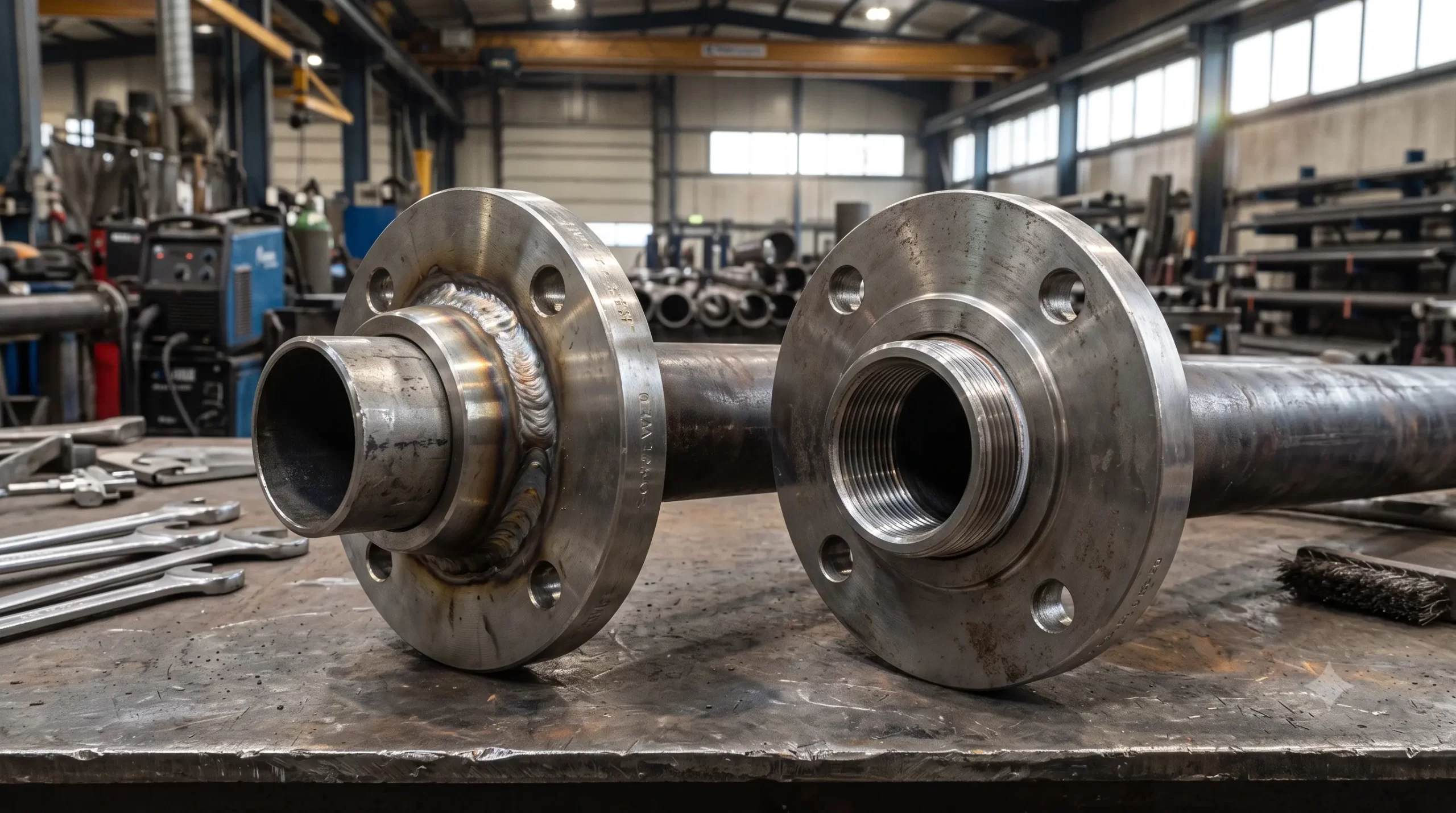
When selecting pipe flanges for industrial piping systems, buyers often compare socket weld vs threaded flanges to determine which connection is better suited to their application. The choice can affect installation time, leakage risk, maintenance requirements, and long-term reliability.
Understanding socket weld vs threaded flanges helps engineers, procurement managers, piping contractors, and plant maintenance teams make informed purchasing decisions. Although both flange types connect piping to equipment and other flanged components, they use different connection methods and have different installation and service considerations.
Both flange types are used to connect piping to equipment, valves, and other flanged components. However, they differ in how the pipe attaches to the flange. A socket weld flange requires a welded connection, whereas a threaded flange uses matching pipe threads and generally avoids welding at the pipe-to-flange joint.
The right selection depends on the piping design, operating pressure and temperature, fluid characteristics, vibration, applicable codes, and project specifications.
What Is a Socket Weld Flange?

A socket weld flange has a recessed socket machined into its bore. The pipe end is inserted into this socket and secured using a fillet weld around the external pipe-to-flange joint.
This connection is commonly used in small-bore piping where a permanent welded joint is preferred. It can be suitable for demanding services when the flange, material, welding procedure, and complete piping system are properly specified.
Key characteristics of socket weld flanges
- Connection method: Pipe inserted into a socket and welded.
- Joint type: Permanent welded connection.
- Installation: Requires qualified welding personnel and appropriate welding procedures.
- Maintenance: Removing the flange normally requires cutting the weld.
- Typical applications: Selected process lines, instrumentation connections, utility piping, and small-bore industrial systems.
Socket weld flanges are often selected when the design calls for a compact welded connection. However, their suitability must be verified against the service conditions and piping code.
What Is a Threaded Flange?

A threaded flange has internal threads in its bore that engage with matching external threads on the pipe. The connection can be assembled without welding the pipe directly to the flange.
Threaded flanges can be useful where welding is impractical, restricted, or undesirable. They may also simplify installation or replacement in suitable piping systems.
Key characteristics of threaded flanges
- Connection method: Matching internal and external pipe threads.
- Joint type: Mechanically assembled threaded connection.
- Installation: Does not normally require pipe-to-flange welding.
- Maintenance: Can be unscrewed if the connection has not been permanently sealed or otherwise restrained.
- Typical applications: Selected utility lines, low-risk services, and locations where hot work restrictions influence the design.
Threaded connections are not automatically suitable for every service without welding. Pressure, temperature, vibration, fluid hazard, and code requirements must be reviewed before selection.
Socket Weld vs Threaded Flanges: Main Differences
The following comparison highlights the main points buyers should consider when preparing a technical specification or requesting a quotation.
| Comparison factor | Socket weld flange | Threaded flange |
|---|---|---|
| Connection method | Fillet-welded pipe connection | Threaded pipe connection |
| Welding | Required at the pipe-to-flange joint | Generally not required |
| Permanence | Permanent unless the weld is cut | Potentially removable |
| Installation resources | Requires welding and related inspection | Requires correct threading and assembly |
| Leakage considerations | Depends on weld quality, design, and inspection | Depends on thread fit, sealing method, and assembly |
| Vibration | Welded joint does not loosen by unscrewing, but fatigue and vibration still require evaluation | Threads may loosen or leak under unsuitable vibration or cyclic conditions |
| Corrosion considerations | Socket geometry can create a crevice at the pipe end | Thread roots can create crevice-corrosion locations |
| Maintenance | Usually requires cutting and rewelding | May be easier to dismantle if accessible and not seal-welded |
| Suitable service | Selected permanent welded piping systems | Selected services where threaded connections are permitted |
| Procurement priority | Confirm weld requirements and material compatibility | Confirm thread standard, size, and sealing requirements |
Important: Neither type is universally better. The decision should follow the project piping class, governing code, and actual operating conditions.
Which Flange Is Better for High-Pressure Applications?
Socket weld flanges are commonly considered for small-bore piping where a permanent welded connection is required. However, the words socket weld alone do not establish the allowable working pressure.
The permitted pressure depends on the flange’s pressure class, material group, operating temperature, applicable standard, and other design requirements.
Threaded flanges can also be manufactured in specified pressure classes, but the threaded joint introduces considerations involving thread integrity, sealing, vibration, and thermal cycling. Certain process services or piping codes restrict threaded joints.
Before choosing either type, verify:
- Design pressure and design temperature.
- Flange size and pressure class.
- Fluid composition and potential hazards.
- Vibration, pulsation, and thermal cycling.
- Piping code and project-specific restrictions.
- Required inspection, testing, and documentation.
For demanding process services, the engineering team should approve the connection type rather than choosing solely on the basis of initial purchase price.
Socket Weld vs Threaded Flanges for Industrial Applications
When evaluating socket weld vs threaded flanges, consider the piping design, operating pressure, temperature, fluid characteristics, and installation requirements. Socket weld flanges provide a permanent welded connection, while threaded flanges allow mechanical assembly where threaded joints are permitted by the applicable piping specification.
For buyers, the decision should not depend on price alone. A suitable flange must meet the project’s material requirements, pressure class, dimensional standard, and service conditions.
Installation and Maintenance Considerations
Installing socket weld flanges
The pipe must fit the flange socket correctly, and the weld must follow the approved welding procedure. Fit-up, cleanliness, material compatibility, and inspection are important for achieving a reliable connection.
The installation procedure should also account for the required clearance between the pipe end and the socket bottom. The exact preparation and acceptance requirements should be taken from the governing code and approved project procedure.
Installing threaded flanges
The pipe and flange must have compatible thread forms, dimensions, and engagement. Thread condition, alignment, and the specified sealing method need to be checked during assembly.
Do not assume that all pipe threads are interchangeable. For example, NPT and BSPT threads have different geometries and should not be mixed unless a specifically engineered, compatible arrangement is approved.
Cost and Installation Considerations
The cost comparison between socket weld vs threaded flanges should include more than the purchase price. Socket weld flange installation requires welding, qualified personnel, and any specified inspection. Threaded flange installation avoids pipe-to-flange welding but requires correctly matched threads and an appropriate sealing arrangement.
Before issuing a purchase order, compare installation costs, maintenance accessibility, inspection requirements, and the consequences of potential leakage.
Which is easier to maintain?
Threaded flanges can be easier to remove where frequent dismantling is part of the design. However, access, corrosion, thread damage, and any seal welding may affect how easily the joint can be disassembled.
Socket weld flanges generally require cutting and rewelding for removal, so maintenance planning should account for that additional work.
Leakage and Corrosion: What Buyers Should Check
Leakage performance depends on the complete connection design and its installation quality, not simply the flange name.
For socket weld flanges, buyers should check welding requirements, material compatibility, inspection requirements, and whether the socket configuration is appropriate for the process fluid. Socket geometry may be unsuitable for certain services where crevice corrosion is a concern.
For threaded flanges, the thread standard, sealing arrangement, assembly procedure, and compatibility with the fluid and operating conditions are important. Threaded joints may be unsuitable for severe cyclic loading, some hazardous services, or other conditions restricted by the applicable piping code.
If the system handles corrosive chemicals, high-purity fluids, hazardous media, or fluids prone to leakage-related safety risks, obtain engineering approval before finalizing the connection.
Materials Used for Socket Weld and Threaded Flanges
Both flange types are available in different materials, depending on the manufacturer, standard, pressure class, size, and service requirements.
Common material options include:
- Carbon steel: Used in many general industrial and process-piping applications.
- Stainless steel: Selected where corrosion resistance and cleanliness requirements influence material selection.
- Alloy steel: Used in specified pressure and temperature conditions.
- Duplex and super duplex stainless steel: Considered for suitable services requiring combinations of strength and corrosion resistance.
- Nickel alloys: Used in selected aggressive or high-temperature environments.
- Monel, Inconel, and Hastelloy alloys: Selected according to the particular corrosion, temperature, and mechanical requirements.
- Titanium and other specialty alloys: Used in applications where their specific corrosion or performance characteristics justify their use.
Material selection must consider the fluid composition, temperature, pressure, corrosion allowance where applicable, mechanical requirements, and project material specification. Do not assume every material is available in every flange type, size, or pressure class.
Which Standards Apply?
For buyers sourcing socket weld and threaded flanges, the following standards are useful starting points:
- ASME B16.5 — Pipe Flanges and Flanged Fittings: The principal standard to check for applicable flange dimensions, pressure-temperature ratings, materials, tolerances, marking, and related requirements.
- ASME B1.20.1 — Pipe Threads, General Purpose (Inch): Relevant when the specified threaded connection uses NPT threads.
- ASME B31.3 — Process Piping: Relevant to process-piping design, fabrication, examination, and testing where this code governs the system.
Confirm the required editions and any additional project, customer, or industry specifications before ordering. These standards serve different purposes and should not be treated as interchangeable.
What Should Buyers Include in an RFQ?
A clear request for quotation helps suppliers identify the correct flange configuration and reduces the risk of incorrect supply.
Include the following information wherever applicable:
- Flange type: socket weld or threaded.
- Nominal pipe size (NPS) or DN.
- Pressure class and applicable standard.
- Material grade and material specification.
- Flange facing, such as raised face or flat face.
- Thread standard and details for threaded flanges.
- Pipe outside diameter, schedule, and wall thickness where relevant.
- Design pressure and temperature.
- Fluid or process service.
- Quantity and required delivery date.
- Inspection, testing, marking, and documentation requirements.
- Material test certificates and traceability requirements, if specified.
If the flange is for a replacement or existing installation, share the approved drawing or existing flange details where possible. This helps the supplier verify dimensions and connection compatibility.
Common Buyer Mistakes to Avoid
Choosing only by price: A cheaper flange may create additional welding, inspection, maintenance, or compatibility costs.
Ignoring the thread specification: A threaded flange must match the intended pipe thread form and dimensions.
Assuming a welded connection is always suitable: Welding may be restricted by the service, material, design, or project requirements.
Ignoring corrosion at the connection: Thread roots and socket geometry can be important when evaluating corrosive or high-purity services.
Ordering without the pressure class or material grade: The flange type alone is not enough to establish suitability.
Overlooking inspection requirements: Confirm the necessary welding, examination, testing, marking, and documentation before placing the order.
How to Select the Right Flange
To choose between socket weld vs threaded flanges, first confirm the required flange size, pressure class, material grade, and applicable standard. Then review vibration, corrosion, thermal cycling, and any project restrictions on threaded or welded joints.
If you are preparing an RFQ, provide the supplier with the complete technical specification so the quoted flange matches the intended application.
Frequently Asked Questions
1. What is the main difference between socket weld and threaded flanges?
A socket weld flange accepts the pipe into a recessed socket and is secured by a fillet weld. A threaded flange connects through matching pipe threads and generally does not require welding at the pipe-to-flange joint.
2. Are socket weld flanges stronger than threaded flanges?
The connection types behave differently, and strength cannot be compared accurately from the name alone. The flange rating, material, joint design, installation quality, loading, and applicable code must all be considered.
3. Can threaded flanges be used in high-pressure piping?
They may be permitted in specific designs and pressure classes, but the complete threaded connection must comply with the governing code and service requirements. Pressure alone is not enough to determine suitability.
4. Are threaded flanges easier to remove?
They can be easier to dismantle because the pipe connection is threaded. However, corrosion, thread damage, access limitations, and seal welding may make removal difficult.
5. Can socket weld flanges be used with stainless steel and alloy materials?
Yes, suitable grades may be available, subject to the applicable standard, product range, and project requirements. The base material, filler material, welding procedure, and service compatibility should be reviewed together.
6. Which flange is better for corrosive service?
There is no universal answer. Both threaded and socket weld connections can present crevice-related concerns. Material selection and connection design should be based on the actual fluid chemistry, temperature, concentration, and applicable engineering requirements.
7. What details are required to purchase socket weld or threaded flanges?
At minimum, specify the flange type, size, pressure class, material grade, applicable standard, and quantity. Threaded flanges also require the correct thread specification. Include facing, inspection, documentation, and delivery requirements where applicable.
Final Thoughts
When comparing socket weld vs threaded flanges, start with the engineering requirements rather than installation convenience alone. Socket weld flanges provide a permanent welded connection, while threaded flanges can simplify assembly and removal in suitable applications.
For procurement teams, the most reliable approach is to confirm the flange standard, material grade, pressure class, connection details, and service conditions before issuing a purchase order. A complete specification helps the supplier quote the correct product and supports safer, more dependable installation.
Jade Special Metals can use this buyer-focused specification approach to support flange enquiries and help customers identify the information needed for accurate product selection. Final suitability should always be verified against the approved project specification and governing piping code.