
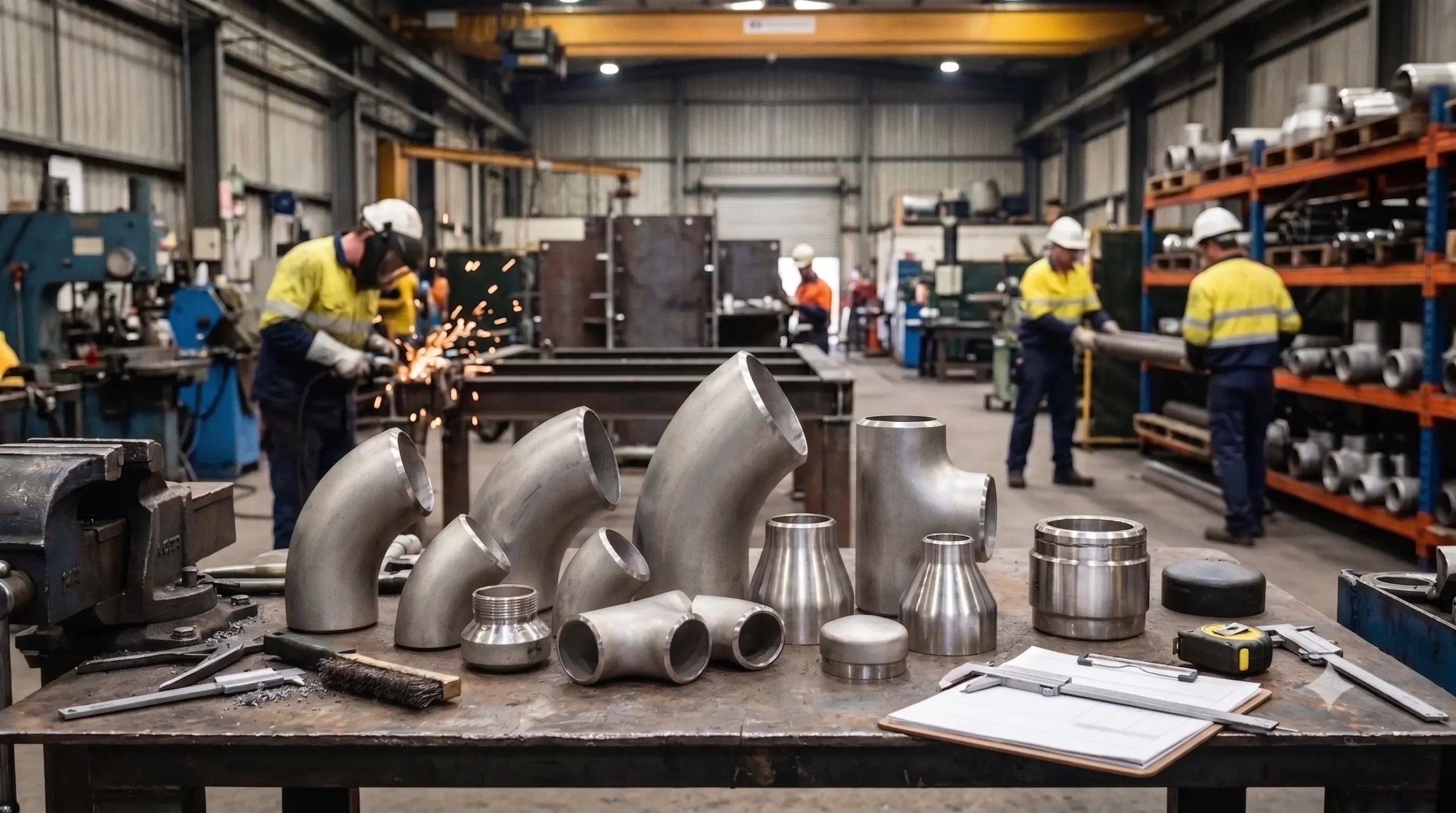
Pipe fittings are some of the most important components in an industrial piping system. While pipes provide the main pathway for transporting liquids, gases, steam, chemicals, and other process media, fittings make it possible to change direction, create branches, connect different pipe sizes, terminate lines, and connect piping to other equipment. Without the right fittings, even a well-designed piping network cannot function properly.
From a small-bore utility line to a large process piping system in an oil refinery, pipe fittings help engineers create practical and reliable piping layouts. Elbows redirect flow, tees create branches, reducers change pipe diameter, caps close pipe ends, and specialized fittings provide connections for specific installation requirements.
The challenge is that fittings are not interchangeable simply because they look similar. Size, material, pressure rating, temperature, connection type, wall thickness, dimensions, corrosion resistance, and applicable standards all influence which fitting is appropriate for a particular service.
This complete guide explains what pipe fittings are, the major types of pipe fittings, materials, connection methods, industrial applications, standards, benefits, selection criteria, and common questions so that buyers, engineers, students, maintenance professionals, and beginners can understand how these essential components work.
What Are Pipe Fittings?
Pipe fittings are mechanical components used to connect, redirect, branch, reduce, extend, or terminate sections of piping. They are installed between pipes or between a pipe and another component such as a valve, flange, pressure vessel, pump, heat exchanger, or other process equipment.
Think of a piping system as a road network. Straight pipes are the roads, while fittings are the intersections, turns, junctions, exits, and endpoints that make the network functional. A piping system would be extremely limited if it consisted only of straight pipe sections.
Depending on the design, fittings can be manufactured with different connection ends, including butt-weld, socket-weld, threaded, flanged, and other specialized connections. The appropriate connection depends on pipe size, pressure, temperature, material, service conditions, installation requirements, and project specifications.
For industrial applications, fittings are manufactured according to recognized standards that establish requirements for dimensions, tolerances, ratings, materials, marking, and testing. For example, ASME B16.9-2024 covers factory-made wrought butt-welding fittings in sizes NPS 1/2 through NPS 48, including overall dimensions, tolerances, ratings, testing, and marking.
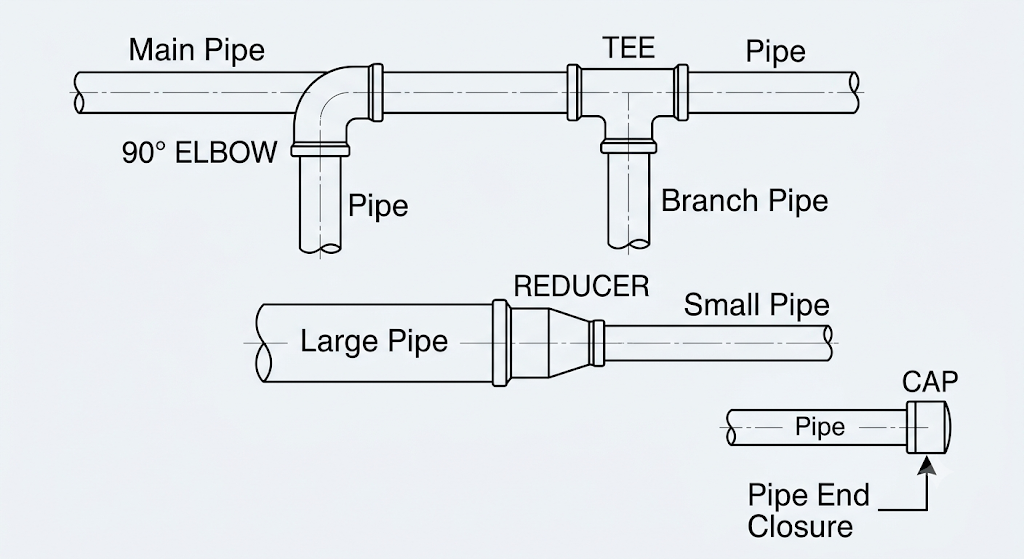
How Pipe Fittings Connect a Piping System
Why Are Pipe Fittings Important?
The importance of pipe fittings becomes obvious when you look at how complicated industrial piping systems can be. A refinery, chemical plant, power station, pharmaceutical facility, or water-treatment plant may contain thousands of metres of piping connected to pumps, vessels, heat exchangers, tanks, valves, instruments, and other equipment.
Straight pipe cannot perform all of these connection functions. Fittings provide the flexibility needed to build the complete system.
A 90-degree elbow, for example, can change the direction of a pipeline. A tee can create a branch from the main line. A reducer can transition from a larger pipe to a smaller pipe. A cap can close a pipeline end. Other fittings can create detachable or specialized connections depending on the piping design.
Choosing the correct component also contributes to system reliability. An unsuitable material may suffer corrosion, while an inappropriate pressure rating or connection configuration may create a serious engineering problem. Correct dimensions are equally important because the fitting must integrate properly with the pipe and mating components.
For this reason, selecting industrial pipe fittings should be treated as an engineering decision rather than simply a purchasing exercise.
Types of Pipe Fittings
There are many different types of pipe fittings, each designed for a particular function. Some change direction, some create branches, some change diameter, and others terminate or connect piping.
The most commonly used industrial fittings include elbows, tees, reducers, caps, crosses, couplings, unions, stub ends, and nipples.
Let’s look at each type.
Elbow Fittings
Elbow fittings are used to change the direction of a piping system. Depending on the design, elbows can redirect flow by 45°, 90°, 180°, or other specified angles.
The 90-degree elbow is one of the most widely used configurations because it allows a pipeline to make a right-angle turn. A 45-degree elbow provides a more gradual directional change, while a 180-degree elbow return is used where the piping needs to reverse direction.
Elbows can also be classified according to their radius. Long-radius elbows have a larger centreline radius and generally provide a smoother directional transition, while short-radius elbows have a tighter turn.
Connection types can include butt-weld, socket-weld, threaded, and other configurations depending on size and service.
Common applications include:
- Oil and gas pipelines
- Refineries
- Petrochemical plants
- Chemical processing
- Power plants
- Water treatment
- General industrial piping
For process piping, elbow selection should consider pressure drop, material, pipe schedule, corrosion conditions, temperature, and applicable standards.
Tee Fittings
A tee fitting is used when a piping system needs a branch connection. It typically has three openings arranged in a T-shaped configuration.
There are two common configurations:
- Equal tee
- Reducing tee
An equal tee has three openings of the same nominal size. A reducing tee has a branch opening smaller than the main run.
For example, a 6-inch main pipeline may require a smaller branch connection for an instrument, utility line, or secondary process stream. A reducing tee can provide this transition within a single fitting.
Tee fittings are widely used in process plants because branch connections are necessary for equipment connections, drainage, sampling, instrumentation, process distribution, and utility services.
The fitting must be selected based on the pipe size, material, wall thickness, connection type, pressure, temperature, and applicable piping specification.
Reducer Fittings
A pipe reducer connects two pipes of different nominal sizes. Reducers are commonly used when a pipeline needs to transition from a larger diameter to a smaller diameter.
There are two major types:
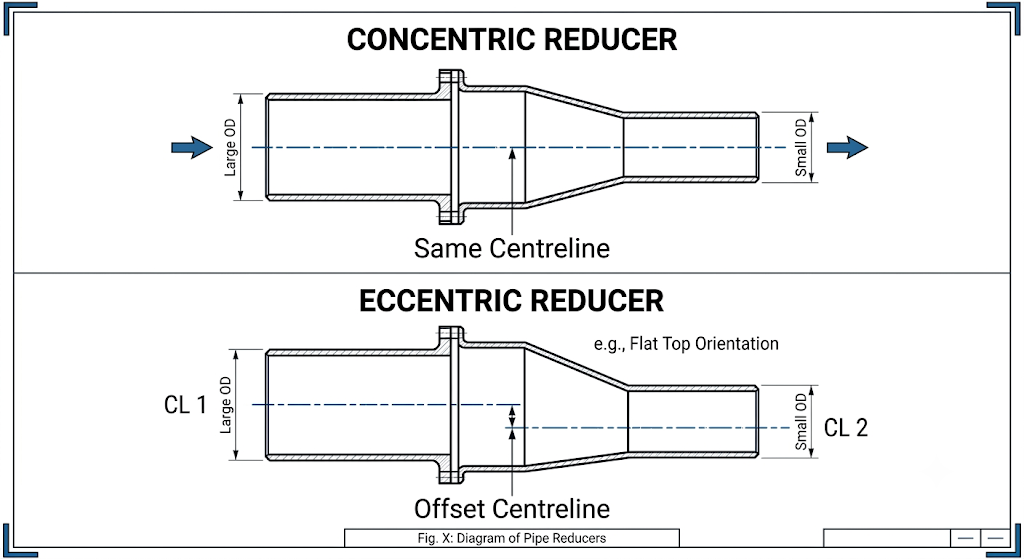
Concentric Reducer
A concentric reducer has a common centreline between the larger and smaller pipe ends.
It is commonly used where maintaining a symmetrical transition is acceptable for the piping arrangement.
Eccentric Reducer
An eccentric reducer has an offset centreline. The flat side of the reducer can be oriented according to the piping arrangement.
This configuration is particularly useful in certain pump, suction, drainage, and horizontal piping applications where maintaining the desired flow or preventing unwanted accumulation is important.
Concentric vs Eccentric Reducer
Cross Fittings
A cross fitting has four openings and can create a four-way piping connection.
Cross fittings are less common than tees in many conventional process systems because the four-way configuration can introduce additional design considerations. However, they may be used in specialized piping arrangements where multiple branches are required at the same point.
Selection should be based on the system design, flow requirements, pressure conditions, material, and applicable standard.
Coupling Fittings
A coupling is used to connect two sections of pipe. Couplings are especially common in smaller-diameter piping systems and can be manufactured with threaded, socket-weld, or other connection configurations.
The primary purpose is straightforward: connect one pipe section to another.
Depending on the application, couplings may be full-size or reducing configurations.
The material and connection method should match the requirements of the piping system.
Union Fittings
A pipe union provides a connection that can be disconnected more easily than a permanently welded joint.
This can be useful for equipment or sections of piping that require periodic maintenance or replacement.
Unions are commonly associated with smaller piping sizes and selected utility or industrial applications.
Their primary advantage is accessibility. Instead of cutting and rewelding a pipe, the connection can be separated according to the union design.
Pipe Caps
A pipe cap is used to close the end of a pipe.
Caps are available in different configurations and materials depending on the piping requirements. In industrial applications, butt-weld caps are commonly used for permanent welded closure of piping.
Caps may be used for:
- Closing unused pipe ends
- Terminating process lines
- Fabricating piping assemblies
- Pressure-containing applications
- Temporary or permanent closure, depending on design
A cap should always be selected according to the pipe size, wall thickness, material, pressure and applicable standard.
Stub Ends
A stub end is a specialized fitting commonly used with lap joint flange assemblies.
The stub end is welded to the pipe while a loose lap joint flange is positioned behind it. This configuration allows the flange to rotate for easier bolt-hole alignment.
Stub ends can be particularly useful in applications where frequent dismantling is expected or where corrosion-resistant wetted materials are required.
For example, an engineering design may use a corrosion-resistant alloy stub end with a different backing flange material, subject to the applicable specifications and service requirements.
Pipe Nipples
A pipe nipple is a short length of pipe used to connect two fittings, valves, or other piping components.
Nipples can be available in several configurations, including:
- Close nipples
- Hex nipples
- Threaded nipples
- Weld nipples
- Reducing nipples
They are frequently used in smaller-diameter piping and equipment connections.
The correct nipple should match the required thread, size, material, schedule, pressure rating, and application.
How Are Pipe Fittings Connected?
The connection method is one of the most important factors when selecting pipe fittings.
Different applications require different connection methods based on pressure, temperature, pipe size, installation conditions, maintenance requirements, and project standards.
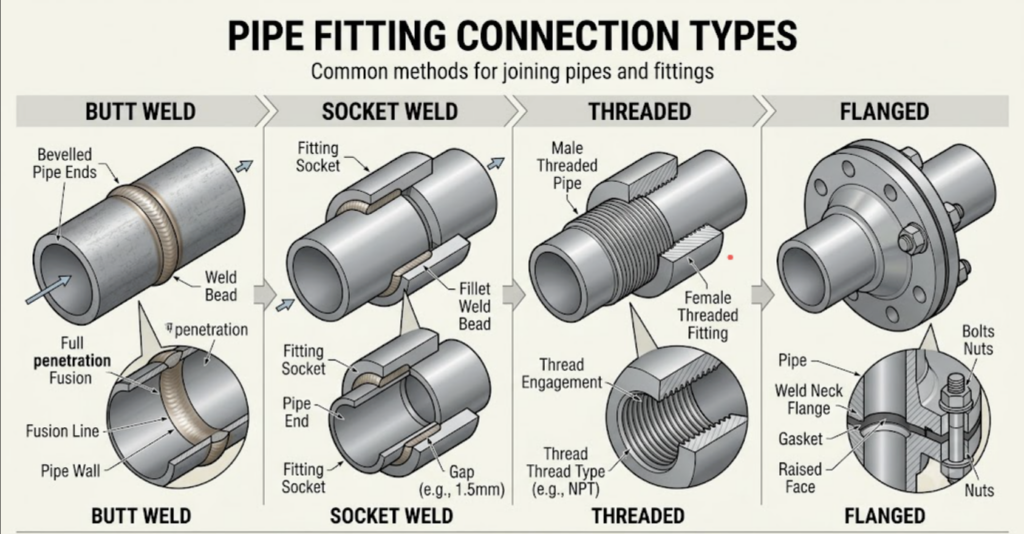
Butt-Weld Fittings
Butt-weld fittings are joined to pipe by welding the fitting end directly to the pipe.
They are widely used in process and industrial piping because they provide a permanent connection with a smooth transition when properly designed and fabricated.
ASME B16.9-2024 covers factory-made wrought butt-welding fittings and includes requirements related to dimensions, tolerances, ratings, testing, and marking.
Typical examples include:
- Butt-weld elbows
- Butt-weld tees
- Butt-weld reducers
- Butt-weld caps
- Stub ends
Socket-Weld Fittings
In a socket-weld connection, the pipe is inserted into a socket in the fitting and welded around the outside.
Socket-weld fittings are commonly associated with smaller-bore industrial piping and applications where a compact welded connection is required.
ASME B16.11 covers forged socket-welding and threaded fittings and specifies requirements including ratings, dimensions, tolerances, marking, and material requirements.
Threaded Fittings
Threaded pipe fittings use internal or external threads to create the connection.
They can be useful where welding is undesirable or impractical, particularly in certain smaller-diameter applications.
Thread compatibility is essential. The fitting and mating component must use compatible thread standards and dimensions.
Flanged Connections
Some piping systems use flanged connections, where the fitting or pipe is connected using mating flanges, gaskets and bolts.
Flanged connections are particularly useful around equipment and components that may need to be removed for inspection or maintenance.
This is where pipe fittings and pipe flanges work together rather than acting as alternatives.
Materials Used for Pipe Fittings
Material selection is one of the most important decisions when specifying pipe fittings.
A fitting that works perfectly in a water system may be unsuitable for a high-temperature chemical process. The material must withstand the mechanical and environmental conditions of the application.
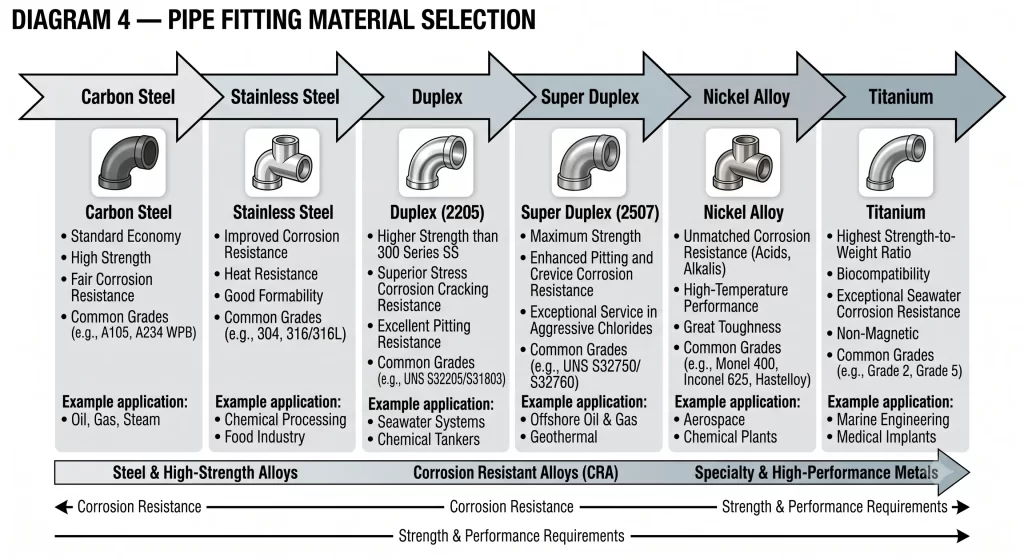
Carbon Steel Pipe Fittings
Carbon steel pipe fittings are widely used in industrial piping because they provide a combination of mechanical strength, availability, and cost effectiveness.
Typical applications include:
- Oil and gas
- Refineries
- General process piping
- Water systems
- Utilities
- Industrial plants
Material selection should consider the specific design temperature, pressure, corrosion environment and applicable material specification.
Stainless Steel Pipe Fittings
Stainless steel pipe fittings are selected when improved corrosion resistance and material performance are required.
Common grades include:
- SS 304
- SS 304L
- SS 316
- SS 316L
Grade selection depends on the chemical environment and operating conditions.
Stainless steel fittings are commonly used in chemical processing, food and beverage, pharmaceutical, water treatment, petrochemical and other applications where corrosion resistance is important.
Alloy Steel Pipe Fittings
Alloy steel fittings can be selected for demanding temperature and mechanical service.
They are used in applications where the properties of carbon steel may not be sufficient for the required operating conditions.
Power generation and high-temperature process services can involve alloy steel components depending on the engineering specification.
Duplex Stainless Steel Pipe Fittings
Duplex stainless steel fittings combine properties associated with austenitic and ferritic stainless steels.
Duplex grades such as 2205 and super duplex grades such as 2507 are used in applications where high strength and corrosion resistance are required.
They can be relevant to:
- Offshore applications
- Marine environments
- Chemical processing
- Petrochemical plants
- Desalination
- Chloride-containing services
Material selection must always be based on the actual process environment and engineering requirements.
Nickel Alloy Pipe Fittings
For highly demanding environments, nickel alloy fittings may be required.
Examples include:
- Inconel
- Monel
- Hastelloy
- Nickel alloys
These materials can offer specialized resistance to corrosion, high temperatures, or aggressive chemical environments depending on the specific grade.
For specialty applications, material selection should be supported by engineering evaluation rather than based solely on the alloy name.
Pipe Fittings Standards
Standards are essential because they provide a common technical framework for manufacturing and specifying components.
For buyers, standards help define dimensions, tolerances, materials, ratings, marking and testing requirements.
ASME B16.9
ASME B16.9 covers factory-made wrought butt-welding fittings. The current edition listed by ASME is B16.9-2024, covering sizes NPS 1/2 through NPS 48.
Typical fittings associated with this standard include:
- Elbows
- Tees
- Reducers
- Caps
- Other butt-welding configurations within the standard’s scope
ASME B16.11
ASME B16.11 covers forged socket-welding and threaded fittings. ASME currently lists the 2021 edition as the applicable edition on its standards page.
The standard covers requirements such as:
- Ratings
- Dimensions
- Tolerances
- Marking
- Material requirements
ASME B16.5
ASME B16.5 applies to pipe flanges and flanged fittings within its defined scope. It becomes particularly relevant when a piping system uses flanged connections.
ASME’s standards information currently lists B16.5-2025 among recently completed standards.
ASME B16.52
For certain nonferrous forged fittings, ASME B16.52-2024 covers titanium, titanium alloys, aluminum and aluminum alloy socket-welding and threaded fittings.
This can be particularly relevant for specialty-material applications where conventional carbon or stainless steel is not suitable.
Applications of Pipe Fittings
Pipe fittings are used across almost every industry that relies on engineered piping systems.
Oil & Gas
Oil and gas facilities use fittings throughout gathering, processing, refining and transportation systems.
Elbows, tees, reducers, caps and other components help route process fluids through complex piping networks.
Petrochemical Industry
Petrochemical plants operate with demanding combinations of pressure, temperature and chemical exposure.
Fitting material and specification therefore become critical design considerations.
Chemical Processing
Chemical plants may handle corrosive or reactive substances, making material selection particularly important.
Stainless steel, duplex and nickel alloys may be considered depending on the process.
Fertilizer Industry
Fertilizer plants contain extensive process piping associated with gases, chemicals, steam, water and other media.
Fittings need to meet the required material, pressure and temperature specifications.
Power Generation
Power plants use piping for steam, condensate, cooling water, fuel and other services.
Depending on the system, fittings may need to withstand elevated temperatures and pressures.
Pharmaceutical Industry
Pharmaceutical facilities require carefully controlled piping systems where cleanliness, material compatibility and process requirements are important.
Stainless steel fittings are commonly encountered in suitable applications.
Water Treatment
Water-treatment systems use fittings for distribution, pumping, filtration, chemical dosing and process connections.
Material choice depends on the water chemistry and operating environment.
Pulp & Paper
Pulp and paper facilities can expose piping components to chemicals, moisture and demanding process conditions.
Fitting selection therefore needs to consider corrosion and mechanical requirements.
Benefits of High-Quality Pipe Fittings
Using properly specified industrial pipe fittings offers several important advantages.
Reliable Piping Connections
Correctly selected fittings help create dependable connections between piping components.
Better System Flexibility
Elbows, tees and reducers allow engineers to design piping around equipment, structures and process requirements.
Corrosion Resistance
Selecting the correct material can improve resistance to the process environment.
Pressure and Temperature Capability
Fittings manufactured to the appropriate specification can be selected for the required operating conditions.
Easier Maintenance
Certain connection types allow components to be removed or replaced more easily than permanent connections.
Long-Term Performance
Proper material selection, manufacturing quality, inspection and installation contribute to reliable service.
The key point is that quality does not come from the fitting alone. It comes from the combination of correct design, material, manufacturing, inspection and installation.
Pipe Fittings vs Pipe Flanges
Pipe fittings and flanges are often discussed together, but they perform different functions.
| Feature | Pipe Fittings | Pipe Flanges |
|---|---|---|
| Main function | Connect, redirect, branch or terminate piping | Create detachable bolted connections |
| Examples | Elbow, tee, reducer, cap | Weld neck, blind, slip-on |
| Connection | Butt weld, socket weld, threaded, etc. | Usually bolted with gasket |
| Typical use | Piping configuration | Equipment and detachable joints |
| Maintenance | Depends on connection | Generally convenient for disassembly |
| Primary purpose | Modify or connect piping geometry | Join components through a flange assembly |
The two products are complementary. A piping system can use elbows, tees and reducers together with flanges, valves and equipment connections to create a complete process network.
Butt-Weld vs Socket-Weld vs Threaded Pipe Fittings
Choosing the connection method depends on the application.
| Feature | Butt-Weld | Socket-Weld | Threaded |
|---|---|---|---|
| Joining method | Butt welding | Fillet welding around socket | Thread engagement |
| Typical application | Process piping | Small-bore piping | Smaller industrial/utility services |
| Welding required | Yes | Yes | No |
| Permanent connection | Yes | Yes | No |
| Installation | Requires welding | Requires welding | Threading/assembly |
| Inspection requirements | Project dependent | Project dependent | Thread inspection |
| Selection factors | Size, pressure, temperature, material | Size, pressure, service | Size, pressure, thread compatibility |
There is no universal “best” connection. The correct choice depends on pipe size, pressure, temperature, fluid, material, accessibility, maintenance requirements and project standards.
Concentric vs Eccentric Reducers
Reducers are another area where choosing the correct configuration matters.
| Feature | Concentric Reducer | Eccentric Reducer |
|---|---|---|
| Centreline | Common centreline | Offset centreline |
| Shape | Symmetrical | Asymmetrical |
| Typical use | General diameter transition | Specific horizontal/suction arrangements |
| Orientation | Generally straightforward | Orientation matters |
| Main purpose | Reduce pipe diameter | Reduce diameter while maintaining desired piping geometry |
The selection should be based on the actual piping layout and engineering requirements rather than simply choosing the more commonly available configuration.
How to Select the Right Pipe Fittings
Selecting the correct pipe fittings starts with understanding the complete service conditions.
1. Determine Pipe Size
Identify the nominal pipe size and required dimensions.
2. Check Wall Thickness or Schedule
The fitting must be compatible with the pipe specification and wall thickness requirements.
3. Identify Pressure Requirements
Determine the design and operating pressure before selecting the fitting configuration and rating.
4. Identify Operating Temperature
Temperature can influence material selection and allowable pressure.
5. Select the Material
Consider:
- Corrosion
- Chemical compatibility
- Mechanical strength
- Temperature
- Process conditions
6. Choose the Fitting Type
Determine whether the system requires:
- Elbow
- Tee
- Reducer
- Cap
- Coupling
- Union
- Stub end
- Nipple
- Other specialized fitting
7. Select the Connection
Choose between:
- Butt weld
- Socket weld
- Threaded
- Flanged
- Other specified connection
8. Verify the Standard
Confirm whether the project requires ASME, ASTM, EN, DIN, JIS or another standard.
9. Confirm Documentation
For critical projects, documentation may include material certificates, inspection reports, traceability records and other project-specific documents.
10. Review the Complete Specification
Before ordering, verify size + schedule + material + fitting type + connection + standard + quantity + inspection requirements.
How Are Pipe Fittings Inspected?
Quality control is important, especially when fittings are intended for pressure-containing or critical industrial service.
Depending on the specification, inspection can include visual examination, dimensional inspection, material verification, positive material identification (PMI), heat-treatment records, non-destructive examination, marking verification, and documentation review.
Not every fitting requires every inspection method. The applicable requirements depend on the product standard, material, service, project specification and purchaser requirements.
Dimensional inspection helps verify that the fitting can be correctly installed with the mating piping. Material verification confirms that the supplied alloy corresponds to the specified grade. Surface examination can identify visible defects or imperfections.
For critical projects, traceability can also be important. The fitting should be identifiable against the relevant manufacturing and material documentation.
This is why buyers should evaluate a supplier based not only on price but also on manufacturing capability, quality systems, inspection procedures, traceability and documentation.
What Should You Specify When Buying Pipe Fittings?
A common purchasing mistake is sending a supplier only a product name such as:
“Need stainless steel elbows.”
That information is usually not enough for an accurate industrial quotation.
A better specification should include:
| Requirement | Example |
|---|---|
| Fitting | 90° Elbow |
| Type | Long Radius |
| Size | 6 inch |
| Schedule | SCH 40 |
| Material | ASTM A403 WP316L |
| Standard | ASME B16.9 |
| Connection | Butt Weld |
| Quantity | As required |
| Inspection | As per project specification |
| Documentation | MTC / required quality documents |
The exact requirements will vary by project.
A complete inquiry reduces misunderstandings and helps the supplier identify the correct product before manufacturing or dispatch.
Common Mistakes When Buying Pipe Fittings
Even experienced buyers can encounter problems if the specification is incomplete.
Choosing Only by Size
A 4-inch fitting can be manufactured in different materials, configurations, schedules and connection types.
Ignoring Material Compatibility
A fitting must be compatible with the process environment.
Mixing Standards
Dimensions and connection details can differ between standards. Compatibility should be verified before ordering.
Selecting the Wrong Reducer
Concentric and eccentric reducers have different geometries and applications.
Ignoring Temperature
Pressure capability and material suitability can depend on operating temperature.
Focusing Only on Price
The lowest quotation may not represent the lowest total project cost if quality, documentation or delivery requirements are not satisfied.
Not Checking Documentation
Critical industrial projects may require traceability and inspection documentation.
Pipe Fittings for Critical Industrial Applications
In demanding industries, the fitting is more than a simple connection component. It becomes part of a pressure-containing system that may operate continuously for years.
For oil & gas, petrochemical, chemical, fertilizer, power, pharmaceutical and other process industries, the specification may include detailed requirements for material grade, manufacturing process, dimensions, heat treatment, testing, inspection and documentation.
Specialty materials can become particularly important when the process contains corrosive chemicals, chlorides, high-temperature fluids or other aggressive media.
For these applications, buyers should work with suppliers capable of understanding engineering specifications rather than treating fittings as generic commodity products.
Pipe Fittings Material Selection Guide
| Material | Typical Strengths | Example Applications |
|---|---|---|
| Carbon Steel | Strength, availability, general industrial use | Oil & gas, utilities, process piping |
| Stainless Steel | Corrosion resistance | Chemical, food, pharmaceutical, water |
| Alloy Steel | High-temperature/mechanical performance | Power, high-temperature process |
| Duplex Stainless Steel | Strength and corrosion resistance | Offshore, chemical, marine |
| Super Duplex | High corrosion resistance and strength | Offshore, desalination, aggressive services |
| Nickel Alloys | Specialized corrosion/high-temperature performance | Chemical, petrochemical, severe services |
| Titanium | Excellent corrosion resistance in selected environments | Chemical, specialty process applications |
The material should always be selected based on the actual operating environment and applicable engineering specification.
Why Choose the Right Pipe Fittings Supplier?
The supplier plays an important role in the overall reliability of a piping project.
A capable pipe fittings supplier should be able to understand technical specifications, identify the correct product, provide appropriate material documentation, maintain dimensional accuracy, support inspection requirements and meet agreed delivery schedules.
For international buyers, additional considerations can include:
- Export experience
- Packaging
- Documentation
- Material traceability
- Quality inspection
- Third-party inspection support
- Technical communication
- Delivery reliability
For specialty-material requirements, supplier capability becomes even more important because not every manufacturer can handle every alloy or specification.
Jade Special Metals can position its expertise around industrial piping products and specialty-material requirements while supporting customers looking for technically specified fittings rather than generic components.
Frequently Asked Questions About Pipe Fittings
What are pipe fittings?
Pipe fittings are components used to connect, redirect, branch, reduce, extend or terminate piping systems. Common examples include elbows, tees, reducers, caps, couplings, unions, nipples and stub ends.
What are the main types of pipe fittings?
The main types include elbows, tees, reducers, crosses, couplings, unions, caps, stub ends and nipples. The correct type depends on the function required in the piping system.
What is a pipe elbow used for?
A pipe elbow changes the direction of a piping system. Common configurations include 45-degree, 90-degree and 180-degree elbows, with long-radius and short-radius designs available for different applications.
What is the difference between a concentric and eccentric reducer?
A concentric reducer has a common centreline between its large and small ends. An eccentric reducer has an offset centreline, making it useful in piping arrangements where maintaining a particular elevation or flow configuration is important.
What materials are used for pipe fittings?
Pipe fittings can be manufactured from carbon steel, stainless steel, alloy steel, duplex stainless steel, super duplex stainless steel, nickel alloys, titanium and other materials, depending on the application.
What is ASME B16.9?
ASME B16.9 is the standard for factory-made wrought butt-welding fittings. ASME’s current listing identifies B16.9-2024, covering sizes NPS 1/2 through NPS 48 and requirements including dimensions, tolerances, ratings, testing and marking.
What is ASME B16.11?
ASME B16.11 covers forged socket-welding and threaded fittings. It addresses requirements including ratings, dimensions, tolerances, marking and material requirements.
How do I choose the right pipe fitting?
Consider pipe size, schedule, pressure, temperature, material, connection type, fitting configuration, applicable standard, corrosion conditions and project requirements. For critical applications, inspection and documentation requirements should also be confirmed.
Are pipe fittings and flanges the same?
No. Pipe fittings such as elbows and tees primarily modify or connect piping geometry, while flanges create detachable bolted connections between piping and components. They are often used together in industrial piping systems.
Why are pipe fitting standards important?
Standards establish consistent requirements for dimensions, tolerances, materials, ratings, marking and testing. Using the correct standard helps ensure that the fitting is suitable for its intended application and compatible with the piping system.
Final Thoughts
Pipe fittings may be smaller than the pipes and equipment around them, but they play a critical role in making industrial piping systems functional. Elbows change direction, tees create branches, reducers change diameter, caps terminate lines, and specialized fittings provide connections for different installation and maintenance requirements.
Choosing the right fitting involves much more than selecting a shape. Material, size, schedule, pressure, temperature, connection type, applicable standard, corrosion resistance and inspection requirements all need to be considered.
For industrial applications, standards such as ASME B16.9 and ASME B16.11 provide important technical frameworks for different fitting categories. ASME’s current standards information identifies B16.9-2024 for factory-made wrought butt-welding fittings and B16.11-2021 for forged socket-welding and threaded fittings.
For buyers, engineers and maintenance teams, the best approach is simple: define the service conditions first, select the appropriate fitting configuration and material, verify the applicable standard, and work with a supplier capable of meeting the technical and documentation requirements.
A correctly specified fitting can become an almost invisible part of a reliable piping system. The wrong one, however, can create installation problems, leakage, corrosion or premature failure. That is why pipe fitting selection should always be treated as an engineering decision, not simply a product purchase.