
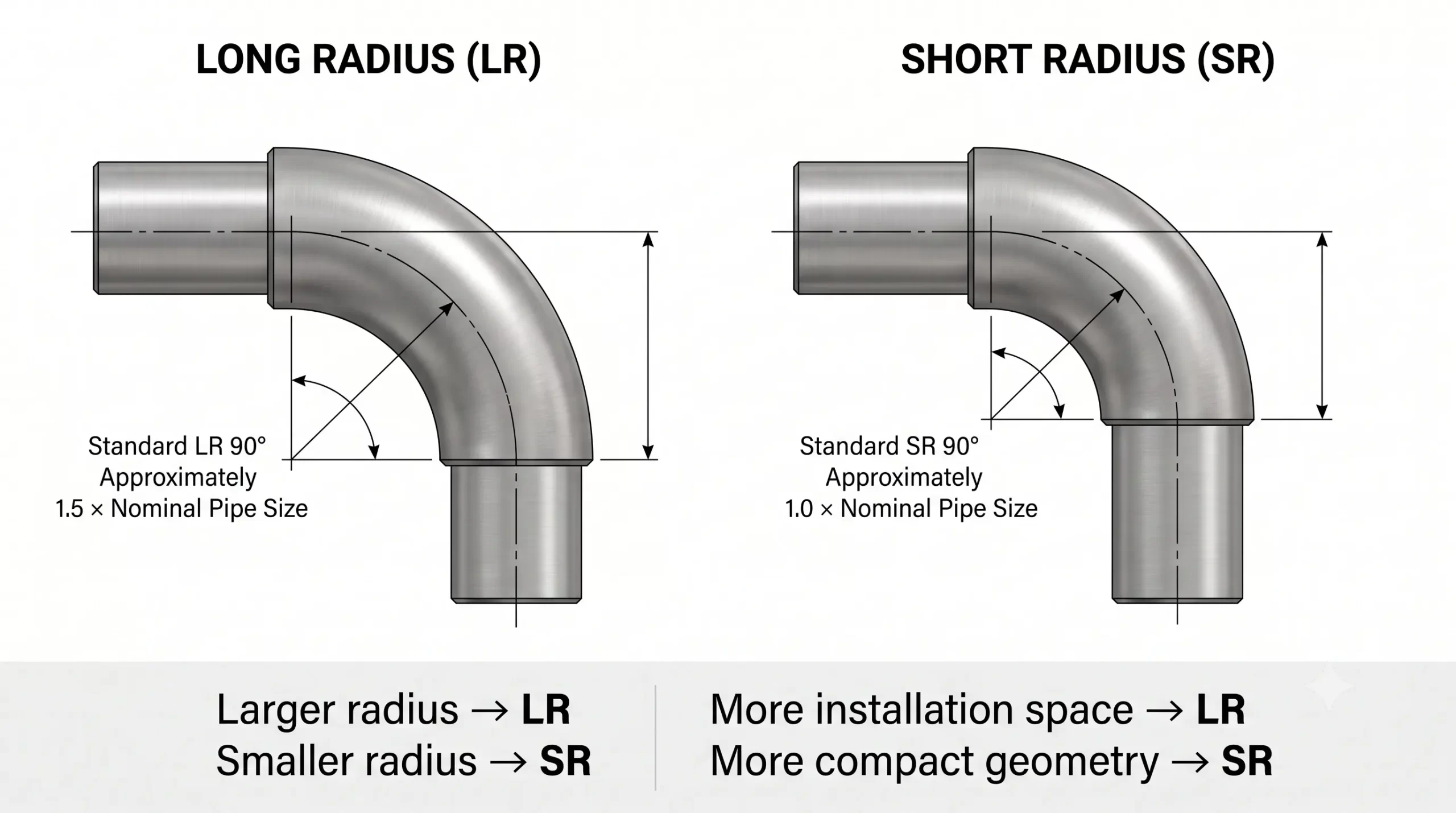
When selecting a 90-degree pipe elbow for an industrial piping system, one of the most important decisions is the bend radius. The two common configurations are Long Radius (LR) elbows and Short Radius (SR) elbows.
At first glance, the difference appears simple: an LR elbow has a larger bend radius, while an SR elbow has a tighter bend. In an actual piping system, however, this difference affects the elbow’s dimensions, space requirements, routing, flow behavior and installation considerations.
Understanding LR vs SR elbows is therefore important for piping engineers, EPC contractors, procurement teams, maintenance engineers and industrial buyers.
In standard 90-degree butt-weld elbow terminology, a long-radius elbow generally has a centerline radius of 1.5 times the nominal pipe size, while a short-radius elbow uses a tighter 1.0-times nominal pipe size radius. The corresponding standard dimensions are specified through the applicable fitting standard. ASME B16.9 is the principal standard for factory-made wrought butt-welding fittings and the current ASME catalogue lists B16.9-2024, Factory-Made Wrought Buttwelding Fittings.
The choice between LR and SR should not be made only by looking at the available space. The piping specification, process conditions, hydraulic requirements, stress analysis and applicable standards should all be considered.
What Is an LR Elbow?
LR stands for Long Radius.
A long-radius elbow has a relatively large centerline radius. For the commonly used standard 90-degree configuration, the centerline radius is generally 1.5 × nominal pipe size (NPS).
For example, for a 4-inch nominal pipe:
LR radius = 1.5 × 4 = 6 inches
This is reflected in standard dimensional tables for long-radius elbows. For example, the ASME B16.9 dimensional data lists a 4 NPS long-radius 90-degree elbow with a center-to-end dimension of 6.00 in (152 mm).
Simplified LR elbow diagram
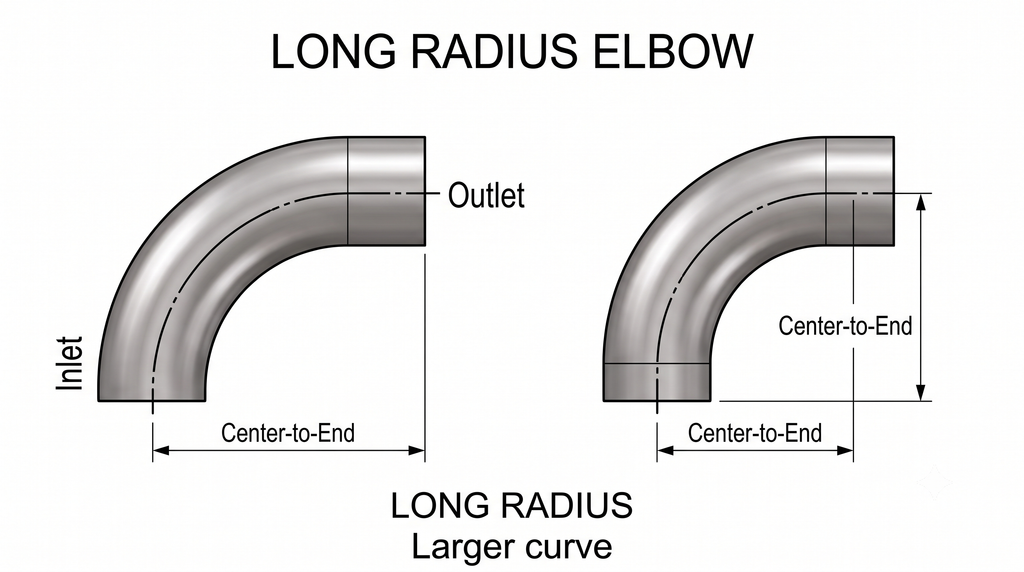
Because the curve is larger, the elbow occupies more space than an equivalent SR elbow.
What Is an SR Elbow?
SR stands for Short Radius.
A short-radius elbow has a tighter bend compared with an LR elbow. For the standard 90-degree configuration, the centerline radius is generally 1.0 × nominal pipe size.
For example, for a 4-inch nominal pipe:
SR radius = 1.0 × 4 = 4 inches
ASME B16.9 dimensional data gives a 4 NPS short-radius elbow with a center-to-end dimension of 4.00 in (102 mm), compared with 6.00 in (152 mm) for the corresponding long-radius elbow.
Simplified SR elbow diagram
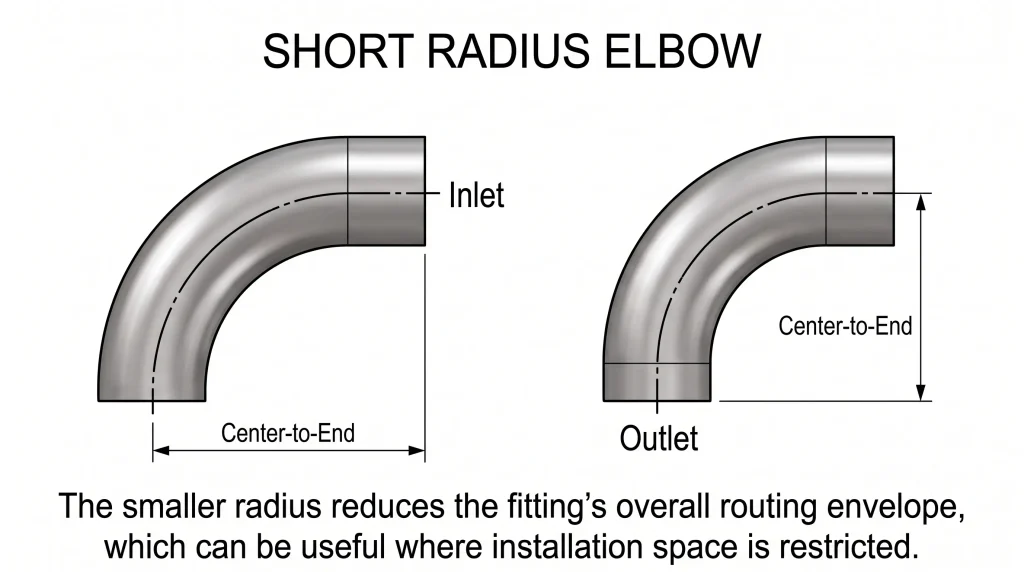
LR vs SR Elbows: The Basic Difference
The simplest way to understand LR vs SR elbows is to compare their centerline radii.
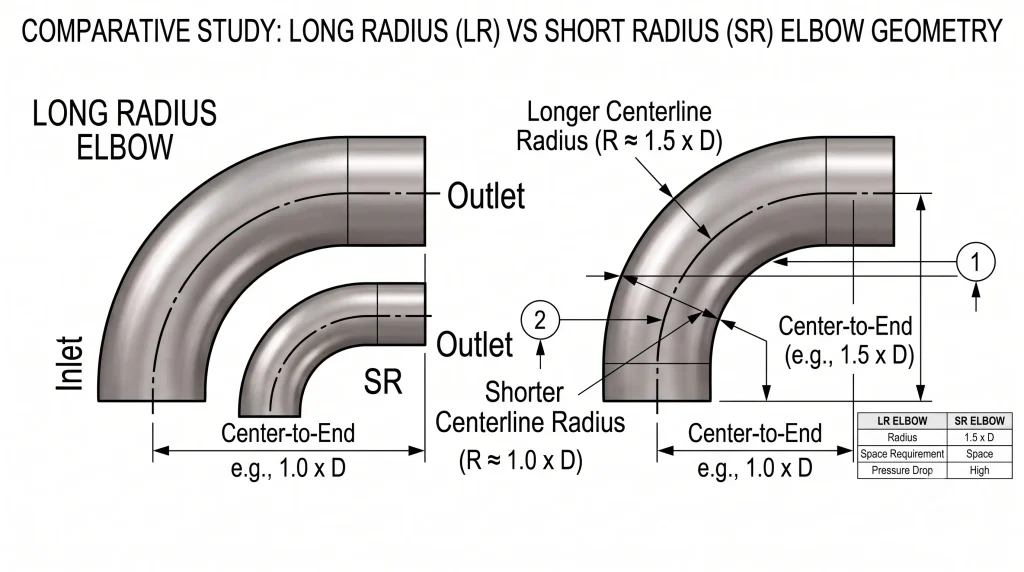
The LR elbow makes the directional change over a larger radius.
The SR elbow makes the same directional change over a shorter radius.
LR vs SR quick comparison
| Parameter | LR Elbow | SR Elbow |
|---|---|---|
| Full form | Long Radius | Short Radius |
| Typical 90° radius | 1.5 × NPS | 1.0 × NPS |
| Bend | Gradual | Tighter |
| Space requirement | More | Less |
| Routing envelope | Larger | Smaller |
| Typical consideration | General/process piping | Space-constrained layouts |
| Flow transition | Generally more gradual | Tighter directional change |
| Selection | Based on piping design | Based on piping design and space |
The table describes the general distinction; actual suitability must be established from the project specification and design conditions.
LR vs SR Elbows: Radius Explained
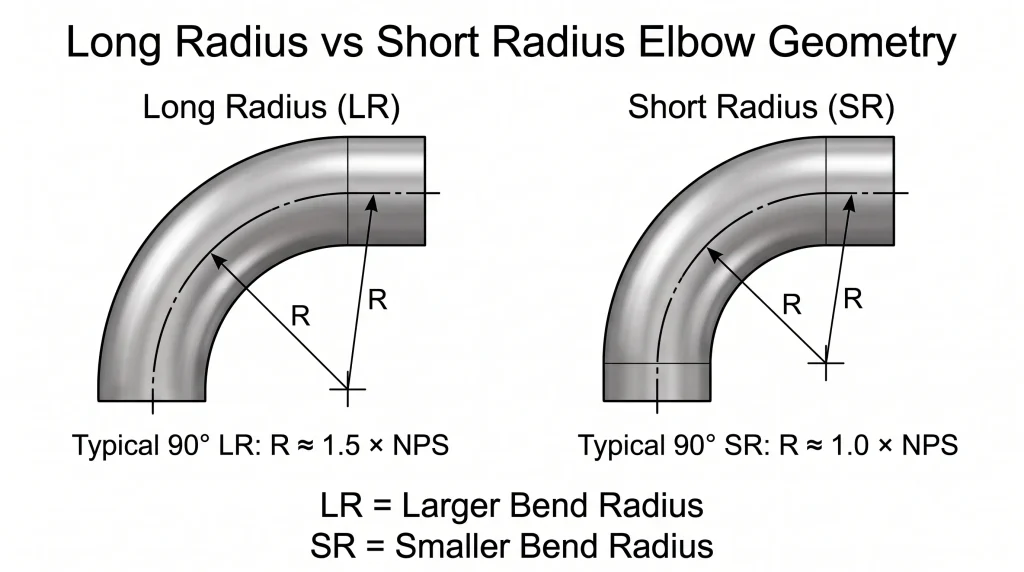
The word radius refers to the centerline radius of the elbow.
It is important not to confuse the elbow’s radius with:
- Outside diameter
- Inside diameter
- Wall thickness
- Back-to-face dimension
- Center-to-end dimension
For standard 90-degree elbows, the relationship can be simplified as:
Long Radius
R ≈ 1.5D
Short Radius
R ≈ 1.0D
Where D represents the nominal pipe size for the conventional LR/SR designation.
For procurement and engineering work, however, dimensional values should be taken from the applicable standard rather than calculated from a simplified rule.
LR vs SR Elbow Dimensions
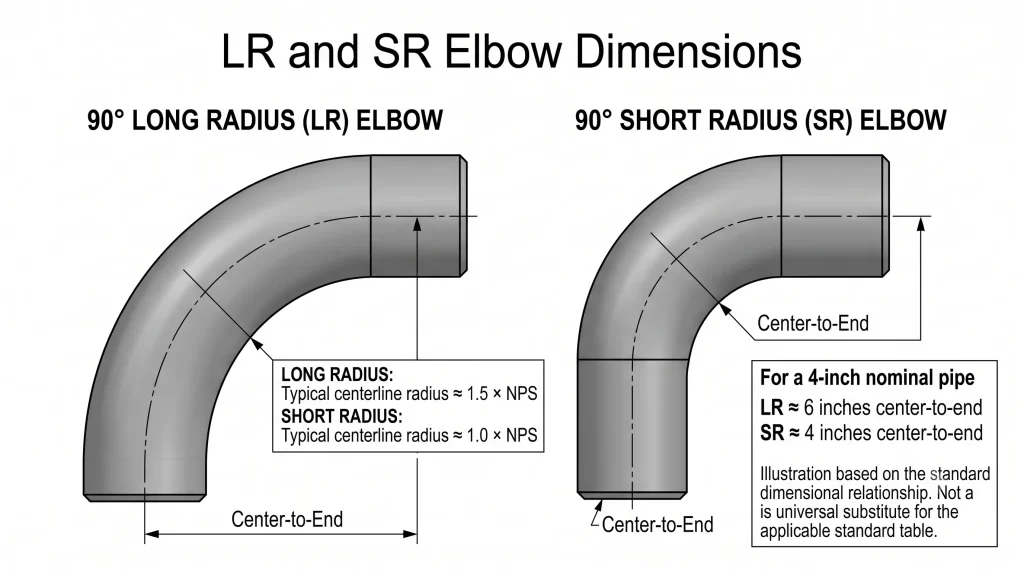
The difference becomes easier to understand when looking at actual standard dimensions.
For a 90-degree elbow, the center-to-end dimension of a standard LR elbow is larger than that of an SR elbow.
| NPS | LR 90° Center-to-End | SR 90° Center-to-End |
|---|---|---|
| 2″ | 3.00 in | 2.00 in |
| 3″ | 4.50 in | 3.00 in |
| 4″ | 6.00 in | 4.00 in |
| 6″ | 9.00 in | 6.00 in |
| 8″ | 12.00 in | 8.00 in |
| 10″ | 15.00 in | 10.00 in |
| 12″ | 18.00 in | 12.00 in |
These values correspond to the standard dimensional relationship shown in ASME B16.9 data.
Example: 6-inch elbow
For a nominal 6-inch pipe:
LR:
6 × 1.5 = 9 inches
SR:
6 × 1.0 = 6 inches
Therefore, the SR configuration reduces the center-to-end dimension by approximately 3 inches for this example.
That dimensional difference can become important in compact piping layouts.
Elbows are available in different angular configurations, with 45° elbows and 90° elbows being common choices depending on the required change in piping direction
LR vs SR Elbows for Piping Layout
Space is one of the clearest practical differences between LR and SR elbows.
Consider a pipe route that must turn 90 degrees close to:
- A pressure vessel
- Heat exchanger
- Pump
- Column
- Structural member
- Platform
- Pipe rack
- Skid boundary
- Equipment nozzle
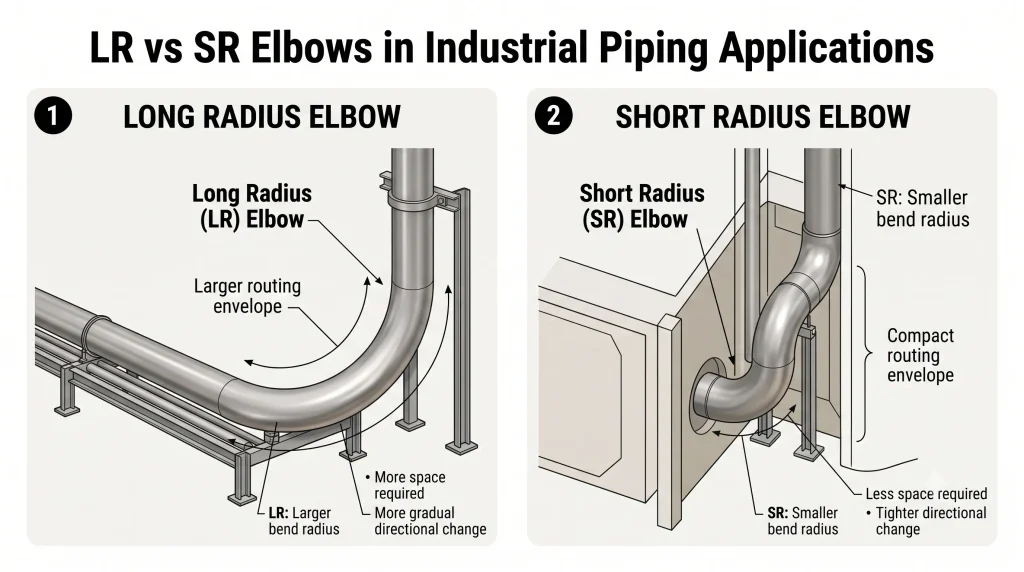
An LR elbow requires more space around the bend.
An SR elbow can fit into a tighter layout.
Conceptual layout
The SR configuration can therefore be useful when the available installation envelope is limited.
However, reducing the physical size of the elbow should not be the only design consideration.
LR vs SR Elbows and Flow
The bend radius influences how the fluid changes direction through the fitting.
A larger radius provides a more gradual directional transition than a tighter radius.
This can influence:
- Pressure loss
- Flow disturbance
- Secondary flow
- Turbulence
- Local velocity distribution
- Erosion tendency in some services
A tighter bend generally creates a more abrupt directional change.
This does not mean that an SR elbow is unsuitable for industrial service. It means the selection should account for the hydraulic and process requirements of the specific piping system.
For systems involving high flow rates, erosive fluids, slurries, sensitive process fluids or demanding hydraulic conditions, the elbow geometry should be reviewed as part of the overall piping design.
For smaller-bore piping and applications using threaded connections, threaded fittings can be considered where the applicable design and service requirements permit.
Does an LR Elbow Have Less Pressure Drop Than an SR Elbow?
Generally, a larger-radius elbow can produce a lower directional loss than a tighter bend under comparable conditions.
The exact pressure loss depends on several factors, including:
- Pipe diameter
- Flow velocity
- Fluid properties
- Reynolds number
- Elbow geometry
- Surface condition
- Number of elbows
- Flow direction
- Piping configuration
Therefore, it is not appropriate to assign one universal pressure-drop value to every LR and SR elbow.
For a critical hydraulic system, pressure-loss calculations should use the appropriate fitting-loss method and project design basis.
LR vs SR Elbows for Erosion and Abrasion
In services containing:
- Solid particles
- Slurries
- Catalyst particles
- Sand
- Abrasive solids
elbow geometry can become particularly important.
A directional change causes the flowing material to change direction. Depending on velocity, particle loading and material properties, this can contribute to localized erosion.
A larger bend radius may provide a more gradual directional transition.
For severe erosive service, however, the engineering assessment should consider:
- Flow velocity
- Particle size
- Particle concentration
- Fluid density
- Elbow material
- Wall thickness
- Bend radius
- Operating temperature
- Corrosion mechanism
Do not select an LR elbow solely because it is assumed to eliminate erosion. Erosion assessment requires service-specific engineering.
LR vs SR Elbows in Process Piping
Process piping systems frequently contain long pipe runs, equipment connections and multiple directional changes.
The selection between LR and SR can depend on:
- Process fluid
- Flow rate
- Pressure
- Temperature
- Piping stress
- Available space
- Equipment layout
- Maintenance access
- Project standards
In many general process-piping arrangements, LR elbows are commonly encountered because the larger radius provides a more gradual directional transition.
SR elbows can be useful where the piping arrangement requires a tighter turn.
Where Are LR Elbows Commonly Used?
Long-radius elbows can be found across many industrial applications.
Typical examples include:
Oil and Gas
Process and utility piping systems often contain LR elbows for routing around equipment and pipe racks.
Refineries
LR elbows may be used throughout process units, utility networks and interconnecting piping.
Petrochemical Plants
The larger radius can be considered for process lines where layout and flow requirements permit.
Chemical Plants
Material selection and process compatibility are critical, while radius selection depends on the piping design.
Power Plants
LR elbows may be used in water, steam, cooling and utility piping systems where the applicable piping specification calls for them.
Water and Wastewater Systems
They can be used in larger-diameter process and utility pipelines.
Where Are SR Elbows Used?
Short-radius elbows are primarily useful when the piping layout has limited space.
Potential applications include:
- Compact skid piping
- Equipment connections
- Space-restricted pipe routing
- Existing plant modifications
- Tight utility layouts
- Certain process piping arrangements
The key point is that an SR elbow is generally selected because its compact geometry satisfies a particular layout or engineering requirement.
LR vs SR Elbows in Equipment Connections
Equipment nozzle orientation can influence elbow selection.
For example, a pipe may need to turn immediately after leaving:
- A vessel nozzle
- Pump nozzle
- Heat exchanger
- Reactor
- Column
- Tank
- Compressor package
If the available distance is limited, an SR elbow may provide the required routing envelope.
If sufficient space is available and the piping design benefits from a larger radius, an LR elbow may be specified.
The final selection should be checked against:
- Nozzle loads
- Piping flexibility
- Support arrangement
- Thermal expansion
- Equipment vendor requirements
- Piping stress analysis
LR vs SR Elbows and Piping Stress
Elbow geometry also matters in piping flexibility and stress analysis.
A piping engineer may evaluate:
- Sustained loads
- Thermal expansion
- Occasional loads
- Seismic loads
- Wind loads
- Equipment nozzle loads
- Support reactions
- Flexibility
Changing an LR elbow to an SR elbow can change the physical geometry of the piping system.
Therefore, an elbow substitution should not automatically be treated as dimensionally interchangeable.
If the piping model or stress analysis was developed using an LR elbow, replacing it with an SR elbow may require engineering review.
LR vs SR Elbows: Installation Considerations
Installation space is another important factor.
LR elbow
Requires a larger routing envelope.
Advantages may include:
- More gradual bend
- More space for routing
- Often preferred for general process layouts
SR elbow
Requires less routing space.
Potential advantages include:
- Compact layout
- Reduced center-to-end dimension
- Useful around congested equipment
But the tighter geometry may require greater attention to:
- Flow behavior
- Welding access
- Stress analysis
- Inspection access
- Service conditions
LR vs SR Elbows: Comparison Table
| Feature | Long Radius (LR) | Short Radius (SR) |
|---|---|---|
| Radius | Approximately 1.5D for standard 90° configuration | Approximately 1D for standard 90° configuration |
| Bend geometry | Larger curve | Tighter curve |
| Center-to-end | Longer | Shorter |
| Space requirement | Higher | Lower |
| Flow transition | More gradual | More abrupt |
| Hydraulic consideration | Generally lower directional loss than tighter bends | Can have higher directional loss |
| Compact piping | Less suitable where space is severely restricted | Useful |
| Process piping | Commonly considered | Used where required |
| Equipment congestion | Requires more clearance | Can fit tighter spaces |
| Stress/layout impact | Larger geometry | More compact geometry |
| Selection basis | Design, flow and layout | Design, flow and space |
| Standard dimensional reference | ASME B16.9 for applicable butt-weld fittings | ASME B16.9 for applicable butt-weld fittings |
LR vs SR Elbows: Which One Should You Specify?
Instead of asking whether LR or SR is universally preferable, ask:
What does the piping system require?
Use the following decision process.
Step 1: Check the piping specification
Look at the project piping class, line list, isometric drawing and applicable standards.
Step 2: Check available space
If there is plenty of space, LR may be practical.
If the piping must fit into a restricted envelope, SR may be considered.
Step 3: Check hydraulic requirements
For critical flow applications, evaluate the effect of elbow geometry on pressure loss and flow behavior.
Step 4: Check piping stress
Confirm that the selected geometry is compatible with the piping flexibility and stress analysis.
Step 5: Check equipment connections
Confirm nozzle orientation, equipment clearances and vendor requirements.
Step 6: Confirm the standard
For applicable factory-made wrought butt-welding elbows, check the required edition and dimensional requirements of ASME B16.9.
LR vs SR Elbows and ASME B16.9
ASME B16.9 is an important reference for factory-made wrought butt-welding fittings.
ASME describes B16.9 as covering overall dimensions, tolerances, ratings, testing and markings for factory-made wrought butt-welding fittings. ASME’s current catalogue lists B16.9-2024.
The standard contains separate dimensional information for long-radius elbows and short-radius elbows.
For example, the published dimensional tables show:
- Long-radius elbows
- Short-radius elbows
- Long-radius returns
- Short-radius returns
- Reducing elbows
- Other applicable butt-weld fittings
This is why procurement specifications should identify the applicable standard rather than simply requesting a “90-degree elbow.”
LR vs SR Elbow Material Selection
Radius is only one part of the elbow specification.
The material must also match the service.
Common materials include:
- Carbon steel
- Stainless steel
- Alloy steel
- Duplex stainless steel
- Super duplex stainless steel
- Nickel alloys
- Titanium
- Other special alloys
For example, ASTM A234/A234M covers wrought carbon steel and alloy steel fittings for moderate- and high-temperature service, including fittings covered by standards such as ASME B16.9 and B16.11. The current ASTM listing identifies A234/A234M-26 as active.
The material grade should therefore be specified separately from the elbow radius.
For example:
90° LR Elbow – ASTM A234 WPB – ASME B16.9 – NPS 6 – Sch 40
is much more useful for procurement than:
6-inch LR elbow
Common Materials for LR and SR Elbows
| Material | Typical Industrial Consideration |
|---|---|
| Carbon Steel | General industrial and process applications |
| Stainless Steel | Corrosion-resistant applications |
| Alloy Steel | Elevated-temperature and demanding services |
| Duplex Stainless Steel | Strength and corrosion resistance |
| Super Duplex | Severe corrosion environments |
| Nickel Alloys | Specialized corrosive/high-temperature services |
| Titanium | Specialized corrosion-resistant applications |
The actual material grade must be selected according to the process specification.
LR vs SR Elbows: Common Procurement Mistakes
Mistake 1: Ordering only by pipe size
“6-inch elbow” is incomplete.
Specify:
Size + angle + radius + material + schedule + standard + quantity
Mistake 2: Assuming every 90° elbow is the same
A 90° LR elbow and 90° SR elbow have different dimensions.
They should not automatically be treated as interchangeable.
Mistake 3: Ignoring piping stress
Changing the elbow geometry can change the piping arrangement and potentially affect stress analysis.
Mistake 4: Selecting SR only because it is smaller
An SR elbow may save space, but the process and hydraulic requirements still need to be considered.
Mistake 5: Selecting LR without checking the layout
An LR elbow may require more clearance than the available space allows.
Mistake 6: Not specifying the material grade
“Stainless steel LR elbow” does not provide enough information for a technical quotation.
Specify the exact grade required by the project.
How to Specify an LR or SR Elbow in an RFQ
A good RFQ should contain the following information:
| Parameter | Example |
|---|---|
| Fitting | Elbow |
| Angle | 90° |
| Radius | LR |
| Size | NPS 6 |
| Material | ASTM A234 WPB |
| Schedule | Sch 40 |
| Standard | ASME B16.9 |
| End connection | Butt weld |
| Quantity | 25 Nos. |
| MTC | Required |
| Inspection | As per project specification |
| Delivery | Project/site location |
Example LR RFQ description
90° Long Radius Butt Weld Elbow, NPS 6, ASTM A234 WPB, Sch 40, ASME B16.9, Quantity 25 Nos.
Example SR RFQ description
90° Short Radius Butt Weld Elbow, NPS 6, ASTM A234 WPB, Sch 40, ASME B16.9, Quantity 25 Nos.
This level of detail makes supplier comparison easier and reduces the possibility of receiving the wrong configuration.
Jade Special Metals for LR and SR Elbows
Jade Special Metals is an industrial pipe fitting supplier based in Girgaon, Mumbai, with a product portfolio covering pipe fittings and related industrial components.
For a buyer sourcing elbows, the important point is to provide the complete technical requirement rather than simply asking for an elbow by nominal size.
A typical enquiry to Jade Special Metals can specify:
Product: 90° LR Butt Weld Elbow
Size: NPS 4
Material: ASTM A234 WPB
Schedule: Sch 40
Standard: ASME B16.9
Quantity: 50 Nos.
MTC: Required
Inspection: As per project requirement
Delivery: Required at project site
For an SR requirement, the radius should be clearly changed to:
Radius: Short Radius (SR)
Jade Special Metals’ published product information covers industrial pipe fittings and elbow categories, making complete technical specifications particularly important when requesting a quotation or checking product availability.
For procurement teams, EPC contractors and industrial buyers, providing the radius at the enquiry stage helps suppliers quote the intended configuration instead of assuming that every 90-degree elbow is long radius.
LR vs SR Elbows: Practical Selection Guide
Use this simplified engineering checklist:
                 START
                   |
                   v
          What is the pipe size?
                   |
                   v
         What angle is required?
                   |
                   v
       Is bend radius specified?
              /           \
            YES            NO
             |              |
             v              v
         Follow          Check project
       specification      piping class
             |              |
             +------->------+
                    |
                    v
             Is space restricted?
                /         \
              YES          NO
               |            |
               v            v
        Consider SR       Consider LR
               |            |
               +------>-----+
                    |
                    v
          Check flow / pressure
               requirements
                    |
                    v
            Check stress analysis
                    |
                    v
          Confirm material + schedule
                    |
                    v
             Confirm standard
                    |
                    v
                ORDER
This is a conceptual selection workflow. Final selection should always follow the approved project specification and engineering design.
LR vs SR Elbows: Frequently Asked Questions
What does LR mean in pipe elbows?
LR means Long Radius. For a conventional 90-degree elbow, the centerline radius is generally 1.5 times the nominal pipe size.
What does SR mean in pipe elbows?
SR means Short Radius. For a conventional 90-degree elbow, the centerline radius is generally 1.0 times the nominal pipe size.
What is the main difference between LR and SR elbows?
The main difference is the bend radius. LR elbows have a larger radius and therefore a longer center-to-end dimension, while SR elbows have a tighter radius and require less space.
Is LR better than SR?
Neither should be considered universally better. The appropriate selection depends on the piping layout, available space, flow requirements, stress analysis and project specification.
Which elbow requires less space?
An SR elbow generally requires less space because its bend radius and center-to-end dimension are smaller.
Which elbow provides a more gradual bend?
An LR elbow provides a larger-radius directional change than an SR elbow.
Do LR and SR elbows have the same dimensions?
No. For the same nominal pipe size and angle, LR and SR elbows have different center-to-end dimensions. ASME B16.9 provides separate dimensional tables for these configurations.
Are LR and SR elbows interchangeable?
Not automatically. Their dimensions differ, and changing the elbow geometry can affect piping layout, clearances and engineering calculations.
What standard covers LR and SR butt-weld elbows?
Applicable factory-made wrought butt-welding elbows are covered by ASME B16.9. The current ASME catalogue lists B16.9-2024.
Can LR and SR elbows be manufactured from the same material?
Yes, depending on the applicable product specification and manufacturing route. Carbon steel, stainless steel, alloy steel and other materials can be specified according to the service and project requirements.
How do I order an LR or SR elbow?
Specify the size, angle, radius, material grade, schedule/wall thickness, connection, applicable standard, quantity and certification/inspection requirements.
Final Thoughts : LR vs SR Elbows
The difference between LR vs SR elbows is primarily the bend radius, but the engineering decision goes beyond dimensions.
A Long Radius (LR) elbow provides a larger-radius directional change and requires more space. A Short Radius (SR) elbow provides a tighter bend and can be useful where the piping layout is restricted.
For a standard 90-degree configuration, LR is generally associated with a centerline radius of approximately 1.5 × nominal pipe size, while SR is associated with approximately 1.0 × nominal pipe size. Standard dimensional tables provide the applicable center-to-end dimensions.
The final selection should consider:
- Pipe size
- Elbow angle
- Bend radius
- Available space
- Flow conditions
- Pressure and temperature
- Material compatibility
- Piping stress
- Equipment nozzle arrangement
- Schedule/wall thickness
- Applicable standards
- Inspection and certification requirements
For procurement, clearly state LR or SR in the RFQ. Do not assume that a supplier will interpret “90-degree elbow” in the same way as the project specification.
When sourcing industrial elbows from Jade Special Metals, providing the complete technical description -such as 90° LR/SR, NPS, material grade, schedule, ASME B16.9 and quantity – helps establish a clear basis for quotation and technical evaluation.