
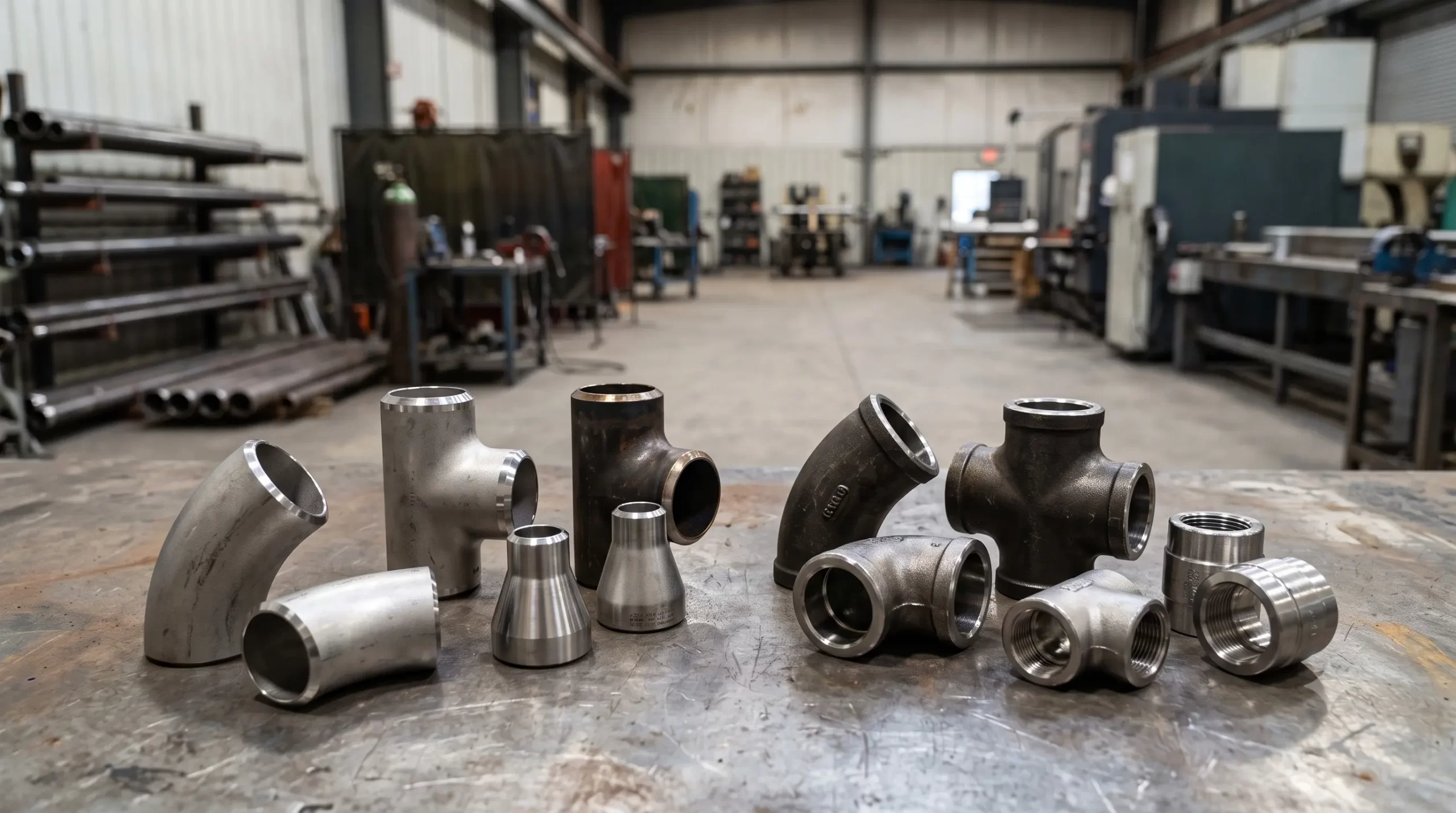
Choosing the right pipe fitting connection can have a major impact on the reliability, fabrication and long-term performance of an industrial piping system. Two of the most widely used welded connection types are butt weld fittings and socket weld fittings. Although both create permanent welded joints, their connection geometry, fabrication method, typical applications and installation requirements are different.
For engineers, procurement professionals and plant operators, understanding the difference between butt weld vs socket weld fittings is important before selecting components for a piping project. A fitting that works perfectly in a small-bore utility line may not be the right choice for a large process pipeline, corrosive chemical service or high-temperature application.
The decision also involves more than just fitting size. Material, pressure, temperature, fluid characteristics, corrosion resistance, applicable piping codes, welding procedures, inspection requirements and project specifications all influence the final selection.
This guide explains butt weld fittings and socket weld fittings in simple terms and compares their construction, applications, advantages, limitations, materials and standards. It also covers important metallurgy options ranging from carbon steel and stainless steel to duplex, super duplex, titanium and nickel alloys.
What Are Butt Weld Fittings?
Butt weld fittings are pipe fittings designed to connect to the pipe through a butt-welded joint. The end of the pipe and the end of the fitting are positioned together and welded around the circumference.
Common examples include elbows, tees, reducers, caps, stub ends and other fittings used to change the direction, size or configuration of a piping system.
The pipe and fitting are normally prepared according to the applicable welding procedure. Depending on the material and wall thickness, the ends may require beveling to establish the required weld profile.
One of the major advantages of this connection is that the fitting can provide a relatively continuous internal passage when correctly designed, aligned and welded. This can be valuable in process piping where flow characteristics, cleaning, pigging or corrosion considerations are important.
ASME B16.9 is one of the principal standards associated with factory-made wrought butt-welding fittings. ASME currently lists B16.9-2024, covering dimensions, tolerances, ratings, testing and marking for factory-made wrought butt-welding fittings from NPS 1/2 through NPS 48.
What Are Socket Weld Fittings?
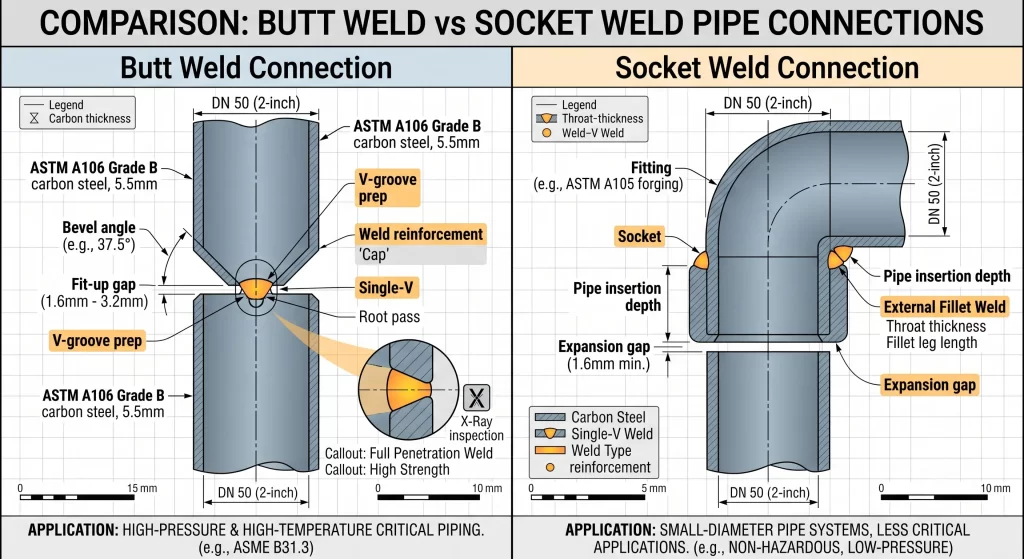
Socket weld fittings use a different connection arrangement. Instead of placing the pipe end directly against the fitting, the pipe is inserted into a recessed socket in the fitting. A fillet weld is then made around the outside of the connection.
Typical socket weld fittings include elbows, tees, couplings, unions, crosses and other forged configurations.
Socket-weld construction is particularly common in smaller-bore piping because the compact fitting design can be convenient for fabrication and installation. It can also be useful where threaded connections are unsuitable but a welded connection is required.
ASME B16.11 is the principal ASME standard associated with forged socket-welding and threaded fittings. ASME identifies B16.11 as covering ratings, dimensions, tolerances, marking and material requirements for these fittings. The standard includes socket-weld fitting classes such as 3000, 6000 and 9000.
Just like butt-weld connections, socket-weld joints must be fabricated and inspected according to the applicable piping code, welding procedure and project specification.
Butt Weld vs Socket Weld Fittings: Basic Difference
The simplest way to understand the difference is to look at how the pipe connects to the fitting.
With a butt weld connection, the pipe and fitting ends meet directly and are welded together.
With a socket weld connection, the pipe enters a recessed socket in the fitting and is then welded around the outside.
That small difference changes the joint geometry and can influence fabrication, inspection, internal flow characteristics and suitability for particular piping applications.
| Feature | Butt Weld Fittings | Socket Weld Fittings |
|---|---|---|
| Connection type | Butt weld | Fillet weld |
| Pipe connection | Pipe end meets fitting end | Pipe enters fitting socket |
| Typical use | Process and medium/large-bore piping | Small-bore piping |
| Common fitting construction | Wrought | Forged |
| Main ASME fitting standard | ASME B16.9 | ASME B16.11 |
| Pipe preparation | Generally requires weld-end preparation | Pipe inserted into socket |
| Alignment | Requires careful end alignment | Socket provides fitting location |
| Internal geometry | Generally continuous transition | Socket geometry must be considered |
| Fabrication | More preparation may be required | Convenient for many small sizes |
| Typical applications | Refineries, chemical plants, process piping | Small-bore process and utility lines |
The table provides a general comparison. Actual selection should always follow the engineering design, piping code and project specification.
7 Key Differences Between Butt Weld and Socket Weld Fittings
1. Connection Design
The most fundamental difference between butt weld fittings and socket weld fittings is their connection geometry.
In a butt-weld joint, the pipe and fitting are aligned end-to-end. The welding procedure then joins the two components around the circumference. Proper preparation and alignment are important because the completed weld forms part of the pressure boundary.
A socket-weld joint uses a recessed area within the fitting. The pipe is inserted into this socket before the external fillet weld is made.
This configuration can make socket-weld fittings convenient for smaller piping arrangements. Butt-weld construction, on the other hand, is particularly useful where a continuous welded piping system is desired.
The selection should therefore be based on the application rather than simply assuming that one connection is universally superior.
2. Typical Pipe Size
Pipe size is one of the first factors engineers consider when comparing these two connection types.
Butt weld fittings are widely used for small, medium and large piping systems. ASME B16.9 covers factory-made wrought butt-welding fittings from NPS 1/2 through NPS 48.
Socket-weld fittings are commonly associated with smaller-bore piping. Their compact forged construction makes them practical where large fitting dimensions are unnecessary.
However, size alone does not determine the connection type.
A small pipe carrying an aggressive chemical may have very different material and connection requirements from a small pipe carrying clean water. Similarly, a large process line may require specific welding, inspection and flow characteristics.
The correct approach is to consider size together with pressure, temperature, material, fluid service, code requirements and fabrication conditions.
3. Internal Flow Characteristics
Internal geometry can be an important consideration in process piping.
A properly fabricated butt-weld connection can create a relatively continuous internal passage between the pipe and fitting. This can be useful where smooth flow, reduced turbulence, cleaning or pigging is important.
A socket-weld connection has a different internal configuration because the pipe extends into the fitting socket. The resulting geometry must therefore be considered in applications where internal flow conditions are particularly sensitive.
This does not mean that socket-weld fittings are unsuitable for process systems. They are widely used in appropriate applications.
The key is to understand the process requirements before selecting the connection.
4. Welding and Fabrication
The fabrication procedures for the two fitting types are different.
With butt weld fittings, the pipe and fitting need to be correctly aligned and prepared before welding. End preparation, bevel angle, root gap, fit-up, welding procedure and heat input can all affect the quality of the finished joint.
Socket-weld fittings use a socket configuration that allows the pipe to be inserted into the fitting before welding. This can simplify certain small-bore fabrication activities, but the joint still needs to comply with the applicable welding and piping requirements.
For process piping, ASME B31.3 addresses requirements related to materials, design, fabrication, assembly, erection, examination, inspection and testing. ASME currently lists B31.3-2024.
The fitting standard and piping code should therefore be considered together.
5. Inspection and Examination
Inspection requirements depend on the application, material, piping code and project specification.
For butt-welded joints, visual inspection and dimensional verification may be supplemented by non-destructive examination such as radiographic testing, ultrasonic testing, liquid penetrant testing or other methods where specified.
Socket-weld joints can also require examination depending on the service classification and project requirements.
Industrial projects may require documentation such as:
- Material Test Certificates
- Heat-number traceability
- Dimensional inspection reports
- Positive Material Identification
- Welding Procedure Specifications
- Procedure Qualification Records
- Welder qualification records
- NDE reports
- Heat-treatment records
- Inspection release documentation
ASME B31.3 includes examination, inspection and testing requirements within its process piping framework.
For critical piping, inspection should be considered during engineering and procurement rather than after fabrication has already started.
6. Space and Installation
Installation conditions can also influence fitting selection.
Socket-weld fittings can be practical in compact small-bore piping because the pipe enters the fitting socket. This can simplify certain fit-up situations.
Butt-weld joints require suitable alignment and welding access. In large process piping this is a normal part of fabrication, but restricted-access locations can make welding more challenging.
The important consideration is not simply which connection is easiest to install. The connection should provide the required combination of mechanical performance, fabrication quality, inspection accessibility and long-term reliability.
7. Cost and Overall Project Economics
Purchase price is only one component of the total cost of a piping connection.
A socket-weld fitting may be attractive for certain small-bore applications because of its compact configuration and fabrication convenience. Butt-weld fittings may require more preparation and alignment, but they can be highly appropriate for process piping and larger lines.
Total installed cost can include:
- Fitting purchase price
- Pipe preparation
- Welding labour
- Welding consumables
- Inspection
- NDE
- Heat treatment
- Material testing
- Installation time
- Documentation
- Maintenance requirements
The cheapest fitting is not necessarily the most economical option over the life of the piping system.
Advantages and Disadvantages Comparison
| Factor | Butt Weld Fittings | Socket Weld Fittings |
|---|---|---|
| Large-bore applications | Excellent suitability | Generally less common |
| Small-bore applications | Suitable | Very common |
| Internal flow | Generally smooth when properly fabricated | Socket geometry requires consideration |
| Fabrication | Requires accurate alignment and preparation | Convenient for many small-bore connections |
| Pipe preparation | Usually more preparation | Generally simpler fit-up |
| Inspection | Project dependent | Project dependent |
| Pressure service | Widely used where specified | Suitable for applicable rated services |
| Common construction | Wrought | Forged |
| Typical standard | ASME B16.9 | ASME B16.11 |
| Best selection basis | Overall system design | Overall system design |
Applications of Butt Weld Fittings
Butt weld fittings are widely used throughout industrial process piping because they provide permanent welded connections across a broad range of sizes and configurations.
Oil and Gas
Refineries, gas-processing facilities and hydrocarbon plants contain extensive piping networks. Elbows, tees, reducers and caps are used to route process fluids and connect different pipe sizes.
Petrochemical
Petrochemical plants operate with complex process streams and demanding pressure and temperature conditions. Material and fitting specifications are selected according to each service.
Chemical Processing
Chemical plants may handle corrosive or hazardous fluids. The fitting metallurgy, welding procedure and inspection requirements therefore become particularly important.
Power Generation
Power plants use piping for steam, feedwater, cooling water, fuel and other services. Alloy and stainless materials may be selected where elevated temperatures or corrosion create additional requirements.
Fertilizer Plants
Fertilizer manufacturing facilities use extensive process and utility piping. Material selection depends heavily on the chemicals, temperature and concentration involved.
Pharmaceutical and Specialty Processing
Stainless steel welded fittings can be used in applications where cleanliness, corrosion resistance and controlled internal surfaces are required.
Applications of Socket Weld Fittings
Socket weld fittings are commonly selected for smaller-bore industrial piping where a compact welded connection is suitable.
Typical applications include:
- Small-bore process piping
- Utility piping
- Instrument-related piping
- Hydraulic systems
- Chemical processing
- High-pressure small-diameter services
- General industrial piping
The actual suitability depends on the piping code, pressure-temperature requirements, material and project specification.
Materials Used for Butt Weld and Socket Weld Fittings
Material selection is one of the most important decisions when specifying butt weld fittings or socket weld fittings.
A fitting must withstand the pressure, temperature, corrosion conditions and mechanical stresses of the piping system throughout its intended service life.
Jade Special Metals can address a broad range of industrial metallurgy, from conventional carbon steel to specialized nickel alloys, titanium and copper-nickel materials.
Stainless Steel
Stainless steel fittings are widely used because they offer a useful combination of corrosion resistance, strength and versatility.
Common grades include 304, 304L, 316 and 316L, while specialized applications may require other stainless grades.
316/316L is commonly selected for applications requiring improved resistance to many chloride-containing and chemical environments compared with 304/304L.
Stainless steel fittings are used in chemical processing, pharmaceutical, food and beverage, water treatment, petrochemical and general industrial applications.
Carbon Steel
Carbon steel fittings are widely used where good mechanical strength, availability and cost-effectiveness are important.
They can be used in water, air, hydrocarbons, steam and general utility services where the environment does not require the corrosion resistance of stainless or nickel alloys.
Carbon steel remains a practical choice for many industrial piping systems, particularly where corrosion allowances, coatings or other protection methods are incorporated into the design.
Alloy Steel
Alloy steel fittings contain additional alloying elements that can improve properties such as high-temperature strength, hardenability and resistance to demanding operating conditions.
Chromium-molybdenum alloy steels are commonly associated with elevated-temperature applications in power generation, refineries and petrochemical facilities.
The exact grade should be selected according to the required mechanical properties, temperature, pressure and applicable specification.
Duplex Steel
Duplex steel fittings combine austenitic and ferritic phases, providing a useful balance of mechanical strength and corrosion resistance.
Grades such as UNS S31803 and UNS S32205 are widely considered for applications where conventional stainless steel may not provide the required combination of strength and corrosion performance.
Duplex fittings are used in oil and gas, marine, chemical processing, desalination and petrochemical applications.
Manufacturing and welding require appropriate control because the final microstructure has an important influence on performance.
Super Duplex Steel
Super duplex steel fittings offer high strength and excellent resistance to localized corrosion in demanding environments.
Common grades include UNS S32750 and UNS S32760.
Super duplex materials are frequently considered for offshore, marine, oil and gas, desalination and chemical-processing applications where chloride resistance is important.
Proper welding and heat-control practices are essential to preserve the intended metallurgical characteristics.
Nickel Alloy
Nickel alloy fittings are selected for severe environments where conventional steels may not provide sufficient corrosion resistance, temperature performance or mechanical properties.
Nickel alloy families include Monel, Inconel, Hastelloy and Alloy 20, among others.
Different nickel alloys have significantly different compositions and properties, so they should never be treated as interchangeable.
The correct alloy should be selected according to the actual process chemistry, temperature and corrosion mechanism.
Monel Alloy
Monel alloys are nickel-copper materials known for corrosion resistance and mechanical strength.
Monel 400 is one of the best-known grades in this family.
Monel can be considered for marine environments, seawater-related systems, chemical processing and certain applications involving hydrofluoric acid.
The specific grade and service conditions should always be reviewed before selection.
Alloy 20
Alloy 20 is a nickel-iron-chromium alloy designed for strong corrosion resistance in several aggressive chemical environments.
It is particularly associated with applications involving sulfuric acid, although suitability depends on concentration, temperature and other service conditions.
Alloy 20 fittings may be used in chemical processing, pharmaceutical manufacturing, food-related process equipment and other corrosive environments.
Inconel Alloy
Inconel alloys are nickel-chromium-based materials developed for demanding high-temperature and corrosion-resistant applications.
Different grades provide different combinations of mechanical strength, oxidation resistance and corrosion performance.
Commonly recognized grades include Inconel 600, 625 and 718, although these materials are not interchangeable.
Inconel fittings may be used in chemical processing, power generation, aerospace-related systems, oil and gas and other severe-service environments.
Hastelloy Alloy
Hastelloy alloys are nickel-based materials known for their resistance to severe corrosion in many aggressive chemical environments.
Hastelloy C-276, for example, is widely used where resistance to a broad range of corrosive conditions is required.
Hastelloy fittings can be found in chemical processing, pollution-control equipment, pharmaceutical applications and other demanding services.
Because Hastelloy is a family of different alloys, the exact grade should be selected according to the process environment.
Titanium Alloy
Titanium alloy fittings are valued for their excellent corrosion resistance-to-weight ratio.
Titanium can be particularly useful in seawater, chloride-containing environments and selected chemical-processing applications.
Titanium Grade 2 is widely used for industrial corrosion-resistant applications, while alloyed titanium grades can provide additional mechanical properties.
Titanium fittings may be used in desalination, marine systems, chemical processing, chlor-alkali facilities and specialized industrial piping.
Proper welding and handling procedures are important because contamination can affect titanium weld quality.
Copper Nickel
Copper nickel (Cu-Ni) fittings are copper-based alloys containing nickel and are particularly valued for seawater and marine service.
Common compositions include 90/10 copper nickel and 70/30 copper nickel.
Cu-Ni fittings are used in marine piping, offshore systems, shipbuilding, seawater cooling and desalination applications.
Their resistance to seawater corrosion and biofouling makes copper nickel an important option for selected marine piping systems.
Metallurgy Comparison for Industrial Pipe Fittings
| Material | Key Characteristics | Typical Applications |
|---|---|---|
| Stainless Steel | Corrosion resistance, strength, versatility | Chemical, pharmaceutical, food, water, petrochemical |
| Carbon Steel | Strength, availability, economical | Utilities, hydrocarbons, general process piping |
| Alloy Steel | High-temperature strength | Power, refinery, high-temperature services |
| Duplex Steel | High strength and corrosion resistance | Oil & gas, marine, chemical, desalination |
| Super Duplex Steel | High strength and chloride resistance | Offshore, seawater, oil & gas, desalination |
| Nickel Alloy | Severe corrosion and temperature resistance | Chemical and specialized process services |
| Monel Alloy | Nickel-copper corrosion resistance | Marine, seawater, chemical processing |
| Alloy 20 | Strong resistance to many acidic environments | Chemical and sulfuric-acid services |
| Inconel Alloy | High-temperature and corrosion performance | Power, chemical, aerospace, oil & gas |
| Hastelloy Alloy | Excellent resistance to severe corrosion | Chemical processing and pollution control |
| Titanium Alloy | Excellent corrosion resistance and low density | Marine, chemical, desalination |
| Copper Nickel | Seawater corrosion resistance | Marine, offshore, seawater cooling |
How to Select the Right Fitting Material
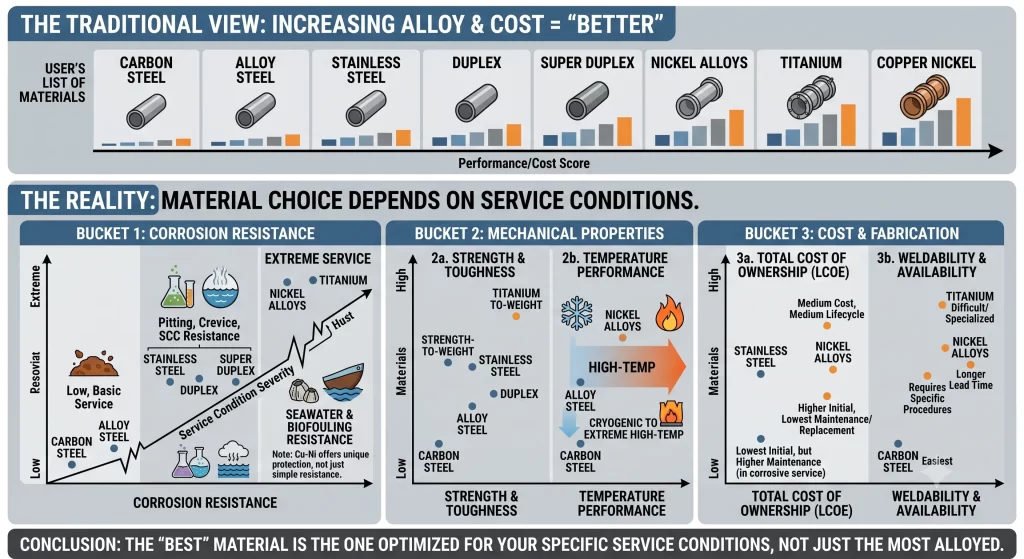
There is no single “best” material for every piping application.
Carbon steel may be highly suitable for a conventional utility service, while duplex or super duplex may be justified when chloride corrosion and mechanical strength become important. A nickel alloy or titanium may be required when the process environment becomes significantly more aggressive.
Before selecting a fitting, evaluate:
- Pipe size and wall thickness
- Design pressure
- Operating and design temperature
- Fluid composition
- Chemical concentration
- Corrosion mechanism
- Required mechanical properties
- Applicable piping code
- Welding requirements
- Inspection and testing requirements
- Expected service life
- Project specifications
The most expensive metallurgy is not automatically the best metallurgy. The objective is to select a material that provides the required performance for the actual service conditions.
Butt Weld vs Socket Weld Fittings: Standards
| Standard | Application | Main Coverage |
|---|---|---|
| ASME B16.9 | Factory-made wrought butt-welding fittings | Dimensions, tolerances, ratings, testing and marking |
| ASME B16.11 | Forged socket-welding and threaded fittings | Ratings, dimensions, tolerances, marking and materials |
| ASME B31.3 | Process piping | Design, materials, fabrication, examination, inspection and testing |
ASME currently lists B16.9-2024, B16.11-2021 and B31.3-2024 on its standards resources.
Always confirm the applicable edition, project specification and jurisdiction before procurement or fabrication.
Common Mistakes When Selecting Pipe Fittings
Selecting Only by Price
A low purchase price does not necessarily mean a low installed or lifecycle cost.
Choosing the Wrong Metallurgy
Material must be compatible with the process fluid and operating environment.
Ignoring Pipe Size
Connection selection depends strongly on pipe size and system configuration.
Ignoring Temperature and Pressure
A fitting must be appropriate for the actual design conditions.
Assuming All Stainless Steel Is the Same
Different stainless grades provide different levels of corrosion resistance and mechanical performance.
Treating All Nickel Alloys as Interchangeable
Monel, Inconel, Hastelloy and Alloy 20 have different compositions and properties.
Ignoring Welding Requirements
Material selection and connection type can influence welding procedures and inspection requirements.
Ignoring Documentation
Industrial projects may require MTCs, traceability, PMI, NDE and other quality records.
Choosing Butt Weld or Socket Weld Without Looking at the Complete System
The fitting should be selected based on the complete piping design rather than connection type alone.
How to Choose Between Butt Weld and Socket Weld Fittings
A simple selection process can help avoid costly mistakes.
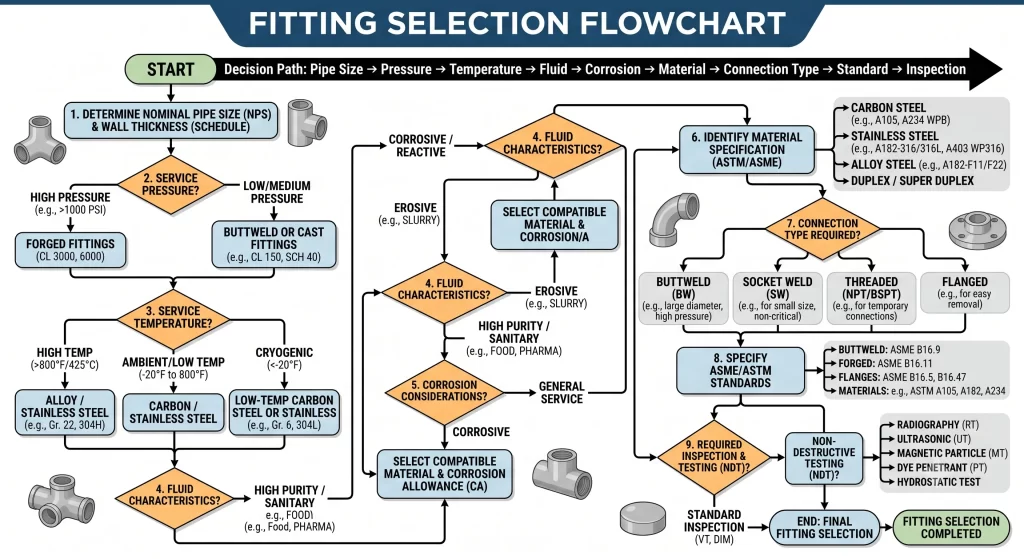
Step 1: Identify the Pipe Size
Start with nominal pipe size, outside diameter and wall thickness.
Step 2: Determine Design Conditions
Establish design pressure, operating pressure, design temperature and operating temperature.
Step 3: Identify the Fluid
Understand whether the system carries water, steam, gas, hydrocarbons, chemicals, seawater or another process fluid.
Step 4: Select the Metallurgy
Choose the material based on corrosion, strength, temperature and compatibility.
Step 5: Check the Piping Code
Identify the governing piping code and project specification.
Step 6: Select the Connection
Determine whether butt weld fittings or socket weld fittings are appropriate.
Step 7: Confirm the Product Standard
For example, ASME B16.9 applies to factory-made wrought butt-welding fittings, while ASME B16.11 covers forged socket-welding and threaded fittings.
Step 8: Confirm Inspection Requirements
Review material certificates, PMI, dimensional inspection, NDE and other requirements.
Step 9: Verify Supplier Capability
Confirm that the supplier can provide the required material, dimensions, standard, traceability and documentation.
Frequently Asked Questions
What is the main difference between butt weld and socket weld fittings?
The main difference is the connection configuration. Butt weld fittings connect to the pipe end-to-end through a butt weld, while socket weld fittings receive the pipe inside a recessed socket and use an external fillet weld.
Are butt weld fittings stronger than socket weld fittings?
Neither connection should be described as universally stronger. Performance depends on the fitting design, material, pipe size, welding procedure, service conditions and applicable piping code.
When should I use butt weld fittings?
They are commonly used in process piping and medium- to large-bore systems where permanent welded connections and a relatively continuous internal passage are desirable.
When should I use socket weld fittings?
They are commonly used for smaller-bore piping where a compact forged fitting and socket-weld connection are suitable for the application.
What standard covers butt weld fittings?
ASME B16.9 covers factory-made wrought butt-welding fittings. ASME currently lists the 2024 edition.
What standard covers socket weld fittings?
ASME B16.11 covers forged socket-welding and threaded fittings. ASME currently lists the 2021 edition.
Can socket weld fittings be used for high-pressure applications?
Yes, socket-weld fittings are available in pressure classes defined by applicable standards, including Classes 3000, 6000 and 9000 under ASME B16.11. However, suitability for a particular high-pressure service must be confirmed against the complete piping design and applicable code.
Can stainless steel be used for both types of fittings?
Yes. Stainless steel is available in both butt-weld and socket-weld configurations, depending on the required size, grade, standard and application.
What materials are available for industrial pipe fittings?
Industrial fittings can be manufactured or supplied in materials including stainless steel, carbon steel, alloy steel, duplex steel, super duplex steel, nickel alloys, Monel, Alloy 20, Inconel, Hastelloy, titanium and copper nickel, depending on the applicable product specification and manufacturer capability.
Are Inconel and Hastelloy the same material?
No. Both are nickel-based alloy families, but their compositions and corrosion-resistant properties differ. The specific grade should be selected according to the actual process environment.
Is duplex steel better than stainless steel?
Not universally. Duplex steel can provide higher strength and excellent corrosion resistance in many demanding environments, but conventional stainless steel may be more appropriate and economical for less severe services.
How do I choose the right metallurgy?
Consider fluid chemistry, concentration, pressure, temperature, corrosion mechanism, mechanical requirements, applicable codes, welding requirements and expected service life. Material selection should be based on the actual service conditions.
Final Thoughts
Understanding butt weld vs socket weld fittings is essential when selecting components for industrial piping systems. Although both provide permanent welded connections, their geometry, fabrication methods, typical applications and installation requirements are different.
Butt weld fittings are widely used in process and larger-bore piping where a continuous welded connection and suitable internal flow profile are important. Socket weld fittings are commonly used in smaller-bore applications where their compact forged configuration and socket connection provide practical advantages.
Material selection is equally important. Depending on the service environment, industrial pipe fittings may be manufactured from carbon steel, alloy steel, stainless steel, duplex steel, super duplex steel, nickel alloys, Monel, Alloy 20, Inconel, Hastelloy, titanium or copper nickel.
The best choice is therefore not simply the fitting that is cheapest, strongest or easiest to install. It is the fitting and metallurgy that satisfy the pipe size, pressure, temperature, fluid chemistry, corrosion requirements, welding procedure, applicable standards and project specifications.
For industrial piping, the right connection starts with understanding the service—and the right metallurgy ensures that the fitting continues to perform long after installation.