When engineers, EPC contractors, project buyers and procurement teams source forged fittings, they are rarely looking for just the cheapest elbow, tee or coupling. They want the correct material, pressure class, dimensions, standard, documentation and delivery schedule—and they want confidence that the fitting will perform reliably after installation.
That is where the choice between forged fittings and butt weld fittings becomes important. Both are widely used in industrial piping, but they are designed around different connection methods, product configurations, size ranges and service requirements. Choosing the wrong fitting can create problems during engineering review, material inspection, fabrication or commissioning.
There is also an important terminology point. “Forged” describes how a fitting is manufactured, while “butt weld” describes how a fitting connects to the pipe. Most forged fittings used under ASME B16.11 are socket-welding or threaded fittings, whereas ASME B16.9 covers factory-made wrought butt-welding fittings.
So, which should a buyer choose?
The answer depends on pipe size, pressure, temperature, process fluid, corrosion conditions, available space, welding requirements and project specifications. This guide explains those differences from an engineering and buyer’s perspective, including materials, standards, applications, inspection, cost, documentation and what you should ask a manufacturer or supplier before placing an order.
What Are Forged Fittings?
Forged fittings are fittings manufactured from metal that is shaped through a forging process and then machined to achieve the required dimensions and connection configuration. In industrial piping, forged fittings are commonly supplied with socket weld or threaded ends, and ASME B16.11 specifies requirements for ratings, dimensions, tolerances, marking and material requirements for these products.
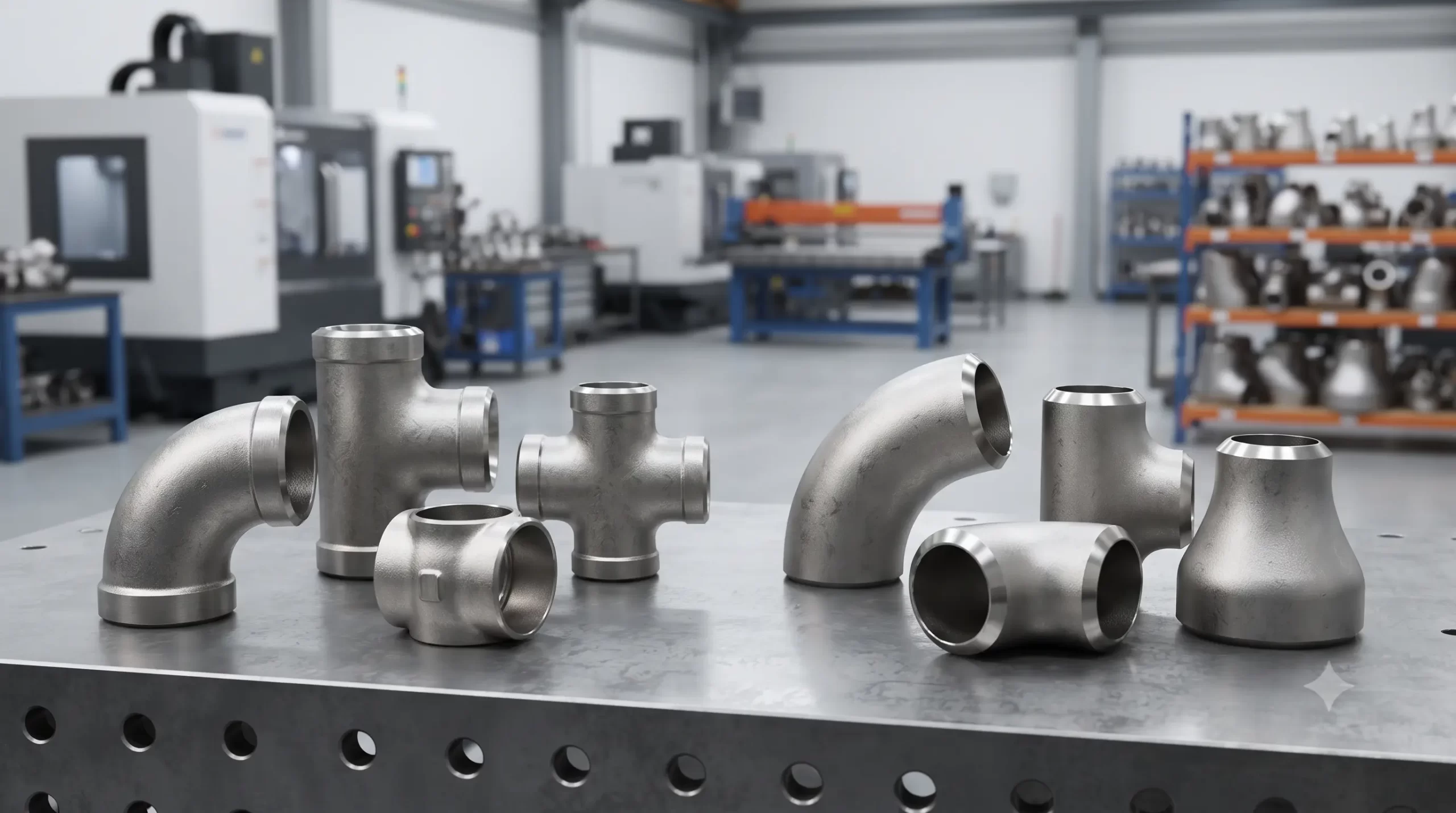
Common forged fitting configurations include elbows, tees, crosses, couplings, half couplings, caps, unions, plugs and bushings. Depending on the product and specification, buyers may encounter carbon steel, stainless steel, alloy steel, duplex, super duplex and nickel-alloy forged fittings.
One of the biggest reasons engineers specify forged fittings is their suitability for compact, high-pressure small-bore piping connections. A forged fitting can provide a robust connection in areas where space is limited or where a large butt-weld fitting would not be practical.
For a buyer, however, the word “forged” alone is not enough. The purchase specification should identify the material grade, pressure class, end connection, size, standard, schedule compatibility, heat treatment and inspection/documentation requirements.
What Are Butt Weld Fittings?
Butt weld fittings are fittings designed to be joined to pipe by a butt-welding process. Typical products include 45° and 90° elbows, long-radius elbows, tees, reducers, caps and other configurations used to change direction, branch a pipeline or transition between pipe sizes.
ASME B16.9 is the principal ASME dimensional standard for factory-made wrought butt-welding fittings. The current ASME listing for B16.9-2024 covers overall dimensions, tolerances, ratings, testing and marking for fittings from NPS 1/2 through NPS 48.
Unlike a socket-weld fitting, the pipe and fitting ends are prepared for a butt weld. This can create a continuous welded piping system with a smooth transition through the fitting when properly designed and fabricated.
Butt weld fittings are therefore widely used in process piping, refineries, petrochemical plants, chemical plants, power projects, oil and gas facilities and other applications where continuous welded piping is preferred.
For buyers, the key is to specify the fitting according to the connected pipe and project requirements rather than simply asking for a “butt weld elbow” or “butt weld tee.”
Forged vs Butt Weld Fittings: The Basic Difference
The most important distinction is that forged and butt weld are not exact opposites.
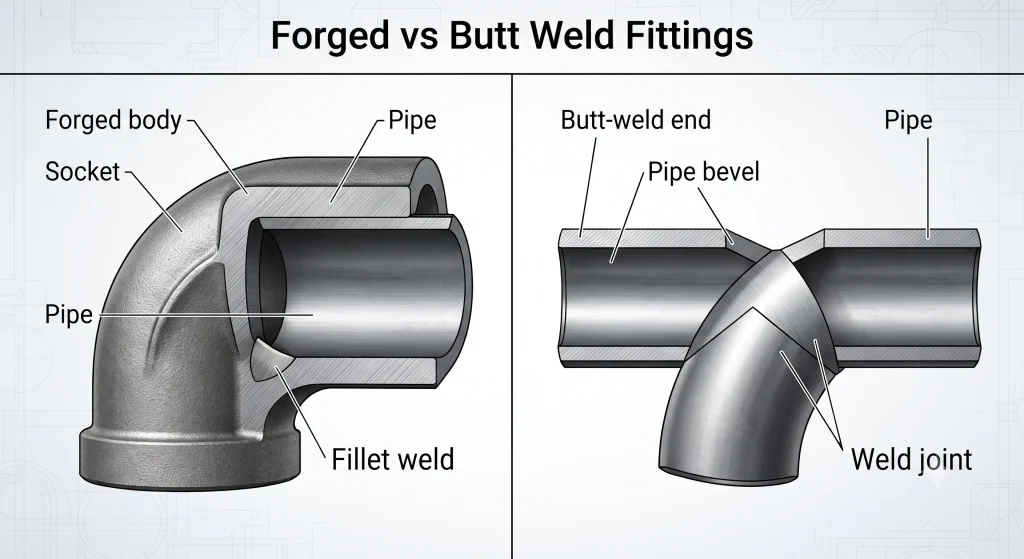
A forged fitting refers primarily to the manufacturing method and product family. A butt weld fitting refers to the end connection. In practice, however, the industrial comparison normally means forged socket-weld/threaded fittings versus factory-made butt-welding fittings.
| Parameter | Forged Fittings | Butt Weld Fittings |
|---|---|---|
| Typical connection | Socket weld or threaded | Butt weld |
| Common ASME standard | ASME B16.11 | ASME B16.9 |
| Typical application | Small-bore piping | Process and larger-bore piping |
| Pressure designation | Pressure classes | Depends on fitting/pipe design |
| Installation | Compact | Requires pipe-end preparation |
| Internal geometry | Socket or threaded connection | Continuous butt-welded transition |
| Common products | Elbow, tee, coupling, cross, union | Elbow, tee, reducer, cap |
| Fabrication | Compact connection | Butt-welding |
| Material options | Carbon, alloy, stainless, duplex, nickel alloys | Carbon, alloy, stainless, duplex, nickel alloys |
| Best selection basis | Size, class, connection and service | Size, schedule, service and welding requirements |
ASME itself defines B16.11 as covering forged socket-welding and threaded fittings, while B16.9 covers factory-made wrought buttwelding fittings.
Key Differences Between Forged and Butt Weld Fittings
1. Manufacturing Process
The first difference is how the products are manufactured.
Forged fittings are produced by shaping suitable metal stock through forging operations and then machining the component to achieve the required geometry. The process creates a compact fitting with the material distributed around the required connection and pressure-bearing geometry.
Butt weld fittings are factory-made wrought components produced through forming processes suitable for the specified material and geometry. The fitting ends are prepared for welding to the pipe.
From a buyer’s perspective, manufacturing route matters because it affects material specification, heat treatment, dimensional control, inspection and documentation.
If you are purchasing forged fittings for an oil and gas project, for example, simply specifying “SS forged elbow” is not enough. Your RFQ may need to identify the exact material grade, class, end connection, standard and inspection requirements.
Likewise, for a butt weld reducer, the buyer should provide the required dimensions, material, wall thickness or schedule, end preparation and applicable standard.
A professional manufacturer should be able to review the specification and identify any missing information before production.
2. Connection Type
Connection method is one of the biggest practical differences.
A forged fitting under ASME B16.11 may be supplied as a socket-weld fitting or a threaded fitting. In a socket-weld connection, the pipe enters a recessed socket and is joined using a fillet weld.
A butt weld fitting, on the other hand, is positioned against the pipe and joined through a butt weld.
This difference affects fabrication, inspection, internal geometry and application suitability.
For small-bore systems, socket-weld forged fittings can be very convenient because the compact connection is relatively straightforward to fabricate. For larger piping systems or applications where a continuous butt-welded piping system is preferred, butt weld fittings become the more natural choice.
The correct decision should always follow the approved piping class and project specification, not simply the preference of the purchasing department.
3. Size and Piping Configuration
Size is one of the most useful practical factors when choosing between the two.
Forged socket-weld and threaded fittings are commonly associated with small-bore piping, while butt weld fittings are widely used across larger process piping sizes. ASME B16.11 and B16.9 have different scopes, so the applicable standard should be checked rather than assuming a universal size cutoff.
For example, a project may use forged socket-weld fittings for small instrument or utility branches and butt weld elbows and tees for the main process piping.
This arrangement can be both technically sensible and commercially efficient.
A buyer should therefore avoid asking a supplier to quote a fitting based only on the nominal pipe diameter. The supplier also needs to know the pipe schedule, material, connection type, pressure class or rating basis and applicable standard.
That information helps prevent an expensive situation where the material arrives but cannot be approved by the engineering or inspection team.
4. Pressure and Service Requirements
Pressure is another major consideration.
ASME B16.11 forged fittings use defined pressure classes. ASME states that the standard includes Class 2000, 3000 and 6000 for threaded fittings and Class 3000, 6000 and 9000 for socket-weld fittings.
Butt weld fittings are integrated into a welded piping system, and their suitability needs to be evaluated alongside the connected pipe, design conditions and governing piping code.
This is why it is not technically correct to say that “forged fittings are always stronger than butt weld fittings.” The actual pressure capability depends on the fitting design, material, wall thickness, temperature, connection and engineering requirements.
For buyers, the correct question is:
“Which fitting and connection configuration is approved for my design pressure, temperature and piping class?”
That question is much more useful than simply asking which product is stronger.
5. Flow and Internal Bore
Internal geometry can influence piping performance.
A butt-welded fitting can provide a relatively smooth transition between the pipe and fitting when correctly designed and fabricated. This is valuable in systems where flow characteristics, pressure drop, cleanability or the avoidance of internal discontinuities matter.
Socket-weld fittings have a socket arrangement in which the pipe enters the fitting. This creates a different internal geometry from a butt-weld connection.
For general utility services, this may not be a significant concern. But for certain corrosive, erosive, high-purity or high-cycle services, engineers may have specific requirements concerning internal geometry and connection configuration.
This is one reason experienced buyers should not select a fitting only by price. The connection itself becomes part of the process system.
6. Installation and Welding
Forged socket-weld fittings can simplify fabrication for suitable small-bore piping because the pipe fits into the socket before welding. The fabricator does not need to prepare a large butt-weld bevel in the same manner as a conventional butt-weld joint.
Butt weld fittings require appropriate pipe-end preparation, alignment and welding procedures. Depending on the project, this may involve additional fabrication and inspection requirements.
That does not make butt welding a disadvantage. In critical process piping, the additional fabrication work can be justified because the resulting connection is designed as part of a continuous welded system.
For project buyers, this difference can influence installation cost, welding hours, consumables, inspection requirements and project schedule.
A supplier who understands these requirements can help the buyer select the most practical fitting instead of simply offering the lowest unit price.
7. Cost and Total Project Value
Purchase price is often the first number buyers compare, but it should not be the only one.
A forged fitting may have a different unit cost from a butt weld fitting, but the final project cost also includes welding, fit-up, inspection, consumables, manpower, material handling and installation.
For a small-bore piping network, a forged socket-weld fitting may offer a compact and practical solution. For a large process pipeline, butt weld fittings may be more appropriate even if the individual fitting requires more fabrication.
The right question is therefore not:
“Which fitting is cheaper?”
It is:
“Which fitting gives the required technical performance at the lowest overall installed and lifecycle cost?”
That is the question procurement teams and project engineers should be asking together.
Forged Fittings: Types Buyers Commonly Order
A professional forged fittings manufacturer or supplier may provide several configurations depending on the required standard and material.
Common products include:
- Forged 90° elbows
- Forged 45° elbows
- Forged tees
- Forged crosses
- Full couplings
- Half couplings
- Unions
- Caps
- Plugs
- Bushings
- Socket-weld fittings
- Threaded fittings
- Branch outlet fittings, where applicable to the project specification
When requesting a quotation, identify the exact fitting type instead of using the generic term forged fitting.
For example:
Forged Socket Weld Elbow, 1½ inch, Class 6000, ASTM A182 F316L, ASME B16.11
is significantly more useful to a manufacturer than:
1½ inch stainless steel forged elbow
The first description provides the information needed to prepare a meaningful technical and commercial quotation.
Butt Weld Fittings: Types Buyers Commonly Order
Butt weld fittings are available in many configurations for industrial piping systems.
Common products include:
- 45° elbows
- 90° elbows
- Long-radius elbows
- Short-radius elbows
- Equal tees
- Reducing tees
- Concentric reducers
- Eccentric reducers
- End caps
- Crosses
- Stub ends
- Special fittings manufactured according to approved drawings
ASME B16.9 covers factory-made wrought butt-welding fittings in sizes NPS 1/2 through NPS 48, with overall dimensions, tolerances, ratings, testing and marking addressed by the standard.
For a manufacturer to quote accurately, the RFQ should ideally include size, schedule/wall thickness, material grade, fitting configuration, standard, quantity, end preparation and any project-specific inspection requirements.
Forged Fittings vs Butt Weld Fittings: Material Selection
The material can completely change the correct fitting choice and manufacturing requirements.
For Jade Special Metals, this is especially important because industrial projects may require everything from conventional carbon steel to highly specialized nickel alloys and titanium.
Stainless Steel
Stainless steel fittings are widely used where corrosion resistance is required. Common grades include 304/304L and 316/316L.
They are frequently specified in chemical processing, food, pharmaceutical, water treatment and general process applications.
Carbon Steel
Carbon steel fittings are popular for general industrial piping because they combine strength, availability and cost effectiveness.
They are commonly used in hydrocarbon, water, air, steam and utility systems where the process environment does not demand a more corrosion-resistant alloy.
Alloy Steel
Alloy steel fittings are used for applications requiring improved high-temperature and mechanical properties.
Chromium-molybdenum grades are common in refinery, petrochemical and power-generation applications.
Duplex Steel
Duplex steel fittings combine austenitic and ferritic metallurgical structures and can provide a useful combination of strength and corrosion resistance.
They are considered for oil and gas, chemical processing, desalination and marine applications.
Super Duplex Steel
Super duplex fittings provide high strength and strong resistance to localized corrosion in demanding environments.
Grades such as UNS S32750 and S32760 are widely associated with offshore, seawater, desalination and chemical-processing applications.
Nickel Alloy
Nickel alloy fittings are selected when conventional stainless steels or carbon steels may not provide sufficient corrosion or temperature resistance.
The correct nickel alloy should always be selected based on the actual process chemistry and operating conditions.
Monel Alloy
Monel alloy fittings are nickel-copper materials used for demanding marine and chemical environments.
They can be particularly attractive for applications involving seawater and selected corrosive media.
Alloy 20
Alloy 20 fittings are used in selected aggressive chemical environments, particularly where resistance to sulfuric-acid-related corrosion is important.
The exact concentration, temperature and process chemistry must be evaluated before final selection.
Inconel Alloy
Inconel fittings are used for demanding high-temperature and corrosion-resistant applications.
Different Inconel grades provide different combinations of strength, oxidation resistance and corrosion resistance, so the grade should be specified rather than simply ordering “Inconel.”
Hastelloy Alloy
Hastelloy fittings are used for severe chemical environments where high corrosion resistance is required.
The appropriate Hastelloy grade depends on the specific chemical environment and temperature.
Titanium Alloy
Titanium fittings offer excellent corrosion resistance and are particularly relevant to seawater, desalination and specialized chemical-processing applications.
Titanium selection requires careful attention to grade, fabrication and compatibility with the service environment.
Copper Nickel
Copper nickel fittings are widely associated with marine and seawater applications.
90/10 and 70/30 copper-nickel alloys are commonly considered where resistance to seawater corrosion is required.
Material Comparison for Industrial Pipe Fittings
| Material | Key Property | Typical Applications |
|---|---|---|
| Carbon Steel | Strength and economy | Oil & gas, utilities |
| Stainless Steel | Corrosion resistance | Chemical, food, water |
| Alloy Steel | High-temperature strength | Power, refinery |
| Duplex Steel | Strength + corrosion resistance | Oil & gas, marine |
| Super Duplex | High strength + chloride resistance | Offshore, seawater |
| Nickel Alloy | Severe corrosion resistance | Chemical processing |
| Monel Alloy | Marine corrosion resistance | Seawater, chemical |
| Alloy 20 | Acid corrosion resistance | Chemical plants |
| Inconel | High-temperature performance | Power, process |
| Hastelloy | Severe chemical resistance | Chemical processing |
| Titanium Alloy | Exceptional corrosion resistance | Desalination, marine |
| Copper Nickel | Seawater resistance | Marine, offshore |
ASME B16.11 vs ASME B16.9
This is one of the most important sections for buyers because the standard often determines what product you actually need.
ASME B16.11 covers forged socket-welding and threaded fittings, including ratings, dimensions, tolerances, marking and material requirements.
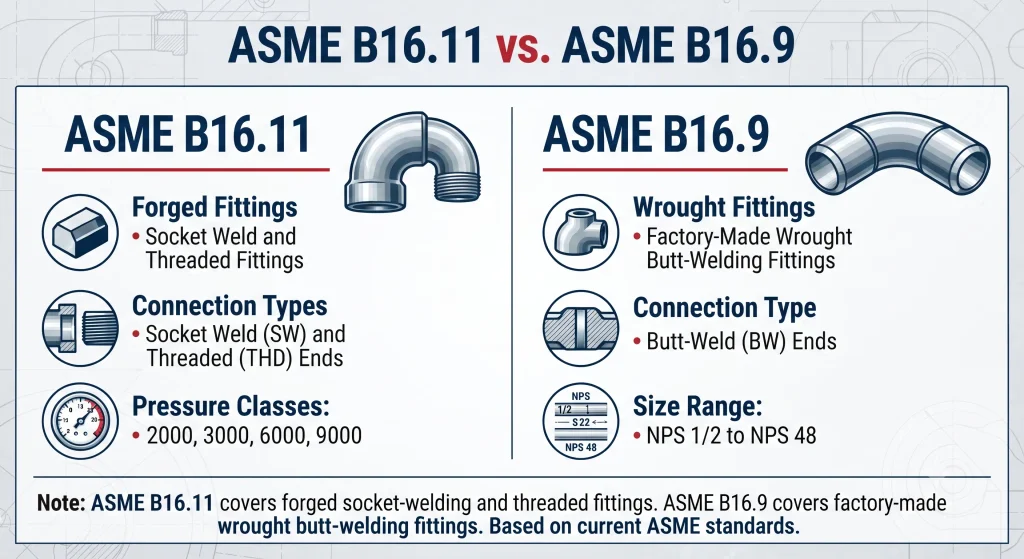
ASME B16.9 covers factory-made wrought butt-welding fittings, including dimensions, tolerances, ratings, testing and marking. The current ASME B16.9-2024 scope extends from NPS 1/2 through NPS 48.
| Requirement | ASME B16.11 | ASME B16.9 |
|---|---|---|
| Product family | Forged fittings | Factory-made wrought BW fittings |
| Connection | Socket weld / threaded | Butt weld |
| Common use | Small-bore piping | Process piping |
| Pressure designation | Classes | Design based on piping system |
| Typical products | Elbows, tees, couplings | Elbows, tees, reducers, caps |
| Size scope | Defined by B16.11 | NPS 1/2–48 |
| Buyer must specify | Size, class, material, connection | Size, wall/schedule, material, configuration |
For technical procurement, always verify the applicable edition and project specification rather than assuming that one standard automatically replaces another.
Forged vs Butt Weld Fittings: Which Is Better?
There is no universal winner.
Forged fittings are often the practical choice for compact small-bore connections where socket-weld or threaded construction is permitted and the required pressure class is suitable.
Butt weld fittings are often preferred for process piping where a continuous welded connection, smooth internal transition and conventional butt-weld fabrication are required.
The right decision depends on:
Pipe size + pressure + temperature + process fluid + material + connection + piping code + project specification.
For a buyer, this means the fitting should be selected as part of the piping system rather than as an isolated component.
What Buyers Should Ask a Forged Fittings Manufacturer
If you are sourcing forged fittings for an EPC project, refinery, chemical plant or industrial piping package, don’t stop at asking for the price.
Ask the manufacturer or supplier for:
Technical Information
- Exact material grade
- Applicable standard
- Pressure class
- Size and dimensions
- End connection
- Wall thickness compatibility
- Heat treatment condition
- Manufacturing process
- Product marking
Quality Documentation
Depending on the project specification, ask whether the supplier can provide:
- Material Test Certificate
- Heat number traceability
- Dimensional inspection report
- PMI report where required
- Hardness report where required
- NDE reports where specified
- Hydrostatic/pressure testing documentation where applicable
- Certificate of conformity
- Third-party inspection support
The exact documentation depends on the purchase specification and applicable code.
Commercial Information
A professional RFQ should also clarify:
- Quantity
- Price basis
- Delivery time
- Packing
- Country of origin
- Payment terms
- Inspection terms
- Warranty
- Export documentation
- Freight terms
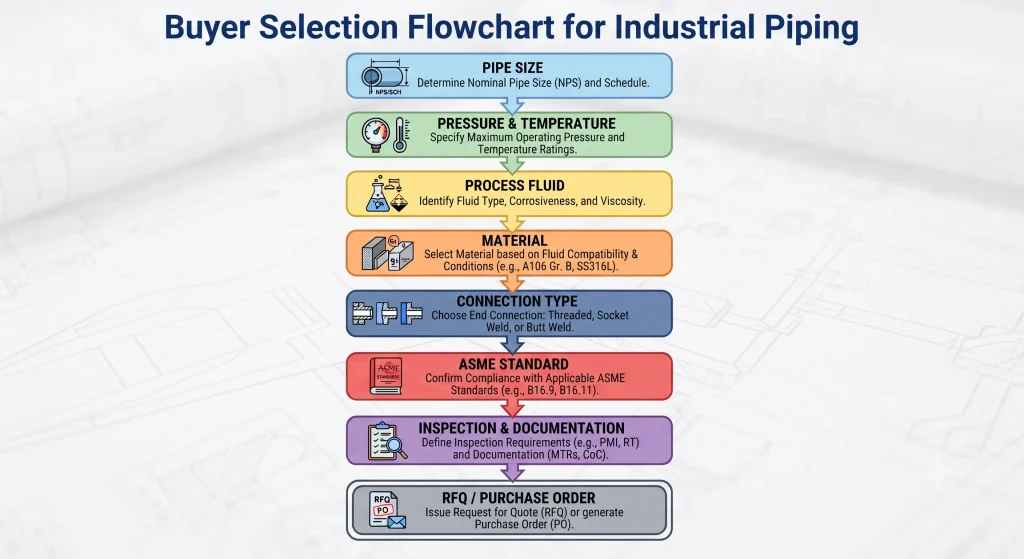
This is particularly important when buying from an overseas manufacturer or sourcing material for a time-sensitive project.
What Buyers Should Ask for Butt Weld Fittings
For a butt weld fitting enquiry, provide as much technical information as possible.
A useful RFQ can include:
Fitting type + size + schedule/wall thickness + material grade + standard + quantity + end preparation + inspection requirement + delivery location
For example:
90° LR Elbow, NPS 6, SCH 40, ASTM A403 WP316L, ASME B16.9, Qty 20 Nos., beveled ends, MTC required, delivery to Mumbai.
This gives the manufacturer enough information to prepare a much more accurate quotation.
For non-standard fittings, include a GA drawing or dimensional sketch wherever possible.
Why Manufacturer Capability Matters
When buyers source industrial fittings, the lowest quotation is not necessarily the lowest-risk quotation.
A capable manufacturer should be able to understand the technical specification, identify missing information, manufacture or source the correct metallurgy, maintain traceability and provide the required documentation.
This becomes particularly important for duplex, super duplex, nickel alloys, titanium and other specialty materials where material control, welding and inspection requirements can be more demanding.
For project procurement, buyers should therefore evaluate:
Technical capability → Quality system → Material traceability → Inspection capability → Manufacturing capacity → Delivery reliability → Documentation → Price
Price comes into the equation—but it should not be the only criterion.
Common Mistakes When Buying Forged or Butt Weld Fittings
One of the most common mistakes is sending a supplier only the fitting name and size.
“2-inch forged elbow” does not tell the manufacturer enough.
Another mistake is confusing forged with socket weld. Forging describes the manufacturing process, while socket weld describes the connection. A buyer should specify both where applicable.
A third mistake is using ASME B16.11 when the project actually requires ASME B16.9 butt weld fittings.
Material is another major issue. Ordering “stainless steel” without identifying the grade can create serious problems because 304L, 316L, duplex and nickel alloys have significantly different properties and costs.
Finally, buyers sometimes ignore documentation until the material has already been manufactured. If the project requires MTCs, PMI, third-party inspection or special NDE, these requirements should be included in the RFQ and purchase order from the beginning.
Which Industries Use Forged and Butt Weld Fittings?
Both product families are used across a wide range of industries.
Oil & Gas
Oil and gas facilities use forged and butt weld fittings throughout process, utility and auxiliary piping systems.
Petrochemical
Petrochemical plants require fittings capable of handling demanding combinations of pressure, temperature and chemical exposure.
Chemical Processing
Material selection becomes especially important in chemical plants because corrosion resistance can determine fitting life and reliability.
Power Generation
Power plants use alloy steel, stainless steel and other specialized materials depending on steam, cooling water and process conditions.
Fertilizer Plants
Fertilizer production can involve aggressive chemicals and elevated temperatures, making metallurgy and fitting specification particularly important.
Pharmaceutical and Food Processing
Hygiene, cleanability, material compatibility and surface requirements can influence fitting selection in specialized process systems.
Marine and Desalination
Duplex, super duplex, titanium and copper nickel fittings are frequently considered for seawater and marine environments where corrosion resistance is critical.
Forged Fittings vs Butt Weld Fittings: Quick Selection Guide
| If your requirement is… | Consider… |
|---|---|
| Small-bore high-pressure piping | Forged socket-weld fittings |
| Threaded connection permitted | Forged threaded fittings |
| Large process piping | Butt weld fittings |
| Continuous welded piping | Butt weld fittings |
| Compact installation | Forged fittings |
| Smooth welded transition | Butt weld fittings |
| High-pressure small-bore service | Forged SW fittings, if approved |
| Corrosive process service | Evaluate butt weld vs SW based on service |
| Large reducers/tees/elbows | Butt weld fittings |
| Project requires ASME B16.11 | Forged fittings |
| Project requires ASME B16.9 | Butt weld fittings |
This table is a starting point, not a substitute for the approved piping specification or engineering design.
How Jade Special Metals Can Support Industrial Fitting Requirements
For buyers, the value of a supplier is not simply having an elbow or tee available in a catalogue.
Industrial projects often require specific metallurgy, dimensions, standards, documentation and delivery schedules. This is especially true when the requirement involves specialty alloys or project-specific inspection.
Jade Special Metals can position its offering around this complete requirement: helping customers identify the correct fitting configuration, material and applicable specification before quotation and supply.
For specialty applications, the material portfolio can include stainless steel, carbon steel, alloy steel, duplex steel, super duplex steel, nickel alloys, Monel, Alloy 20, Inconel, Hastelloy, titanium and copper nickel, subject to the required grade, product specification and manufacturing route.
For buyers preparing an RFQ, the best approach is to send the complete material requisition, datasheet, piping class or fitting schedule wherever available. This allows the supplier to quote against the actual requirement rather than making assumptions.
Frequently Asked Questions
Are forged fittings and butt weld fittings the same?
No. Forged fittings describe a manufacturing/product category, while butt weld fittings describe fittings designed for butt-weld connections. ASME B16.11 covers forged socket-welding and threaded fittings, while ASME B16.9 covers factory-made wrought butt-welding fittings.
Are forged fittings stronger than butt weld fittings?
It is not correct to make a blanket statement that forged fittings are always stronger. Performance depends on material, design, pressure class, temperature, connection configuration and applicable piping code.
What standard is used for forged fittings?
ASME B16.11 covers forged socket-welding and threaded fittings, including ratings, dimensions, tolerances, marking and material requirements.
Are forged fittings suitable for high-pressure piping?
Yes, appropriately specified forged socket-weld fittings are widely used for high-pressure small-bore piping. ASME B16.11 includes Class 3000, 6000 and 9000 socket-weld fittings.
Are butt weld fittings better for large piping?
Butt weld fittings are commonly used for larger process piping because they integrate directly with the pipe through butt welding. The final choice should follow the piping design, applicable standard and project specification.
Which is cheaper, forged or butt weld fittings?
There is no universal price winner. Unit cost, material grade, size, pressure class, quantity, manufacturing route and delivery requirements all influence pricing. Total installed cost should also consider welding and inspection.
Can forged fittings be made from stainless steel?
Yes. Forged fittings are available in various stainless steel grades and other alloy systems, subject to the applicable material and product specification.
What information should I provide when requesting a quotation?
At minimum, provide fitting type, size, material grade, connection type, pressure class or schedule, applicable standard, quantity and delivery location. For project requirements, also provide the datasheet, piping class, inspection requirements and documentation requirements.
How do I choose between forged and butt weld fittings?
Start with pipe size and connection requirements, then evaluate pressure, temperature, process fluid, corrosion, material, installation method, inspection requirements and project specifications. The correct fitting is the one that satisfies the complete engineering requirement—not simply the one with the lowest purchase price.
Final Thoughts
Choosing between forged fittings and butt weld fittings is ultimately about matching the fitting to the piping system.
Forged socket-weld or threaded fittings can provide a compact and robust solution for suitable small-bore applications, while butt weld fittings are widely used for process piping where direct butt-welding and a continuous welded piping arrangement are required.
The most important point for buyers is that “forged” and “butt weld” are not direct opposites. One primarily describes manufacturing, while the other describes connection configuration. Understanding that distinction prevents specification errors and makes the purchasing process much easier.
For any industrial project, confirm the material grade, size, pressure class or wall thickness, connection, applicable ASME standard, inspection requirements, documentation and delivery schedule before placing an order.
For specialty metallurgy—whether stainless steel, carbon steel, alloy steel, duplex, super duplex, nickel alloy, Monel, Alloy 20, Inconel, Hastelloy, titanium or copper nickel—the supplier’s technical capability and material traceability are just as important as the quoted price.
At Jade Special Metals, the objective should not simply be to supply a fitting. It should be to help buyers obtain the right fitting, in the right material, to the right specification, with the right documentation and delivery commitment.
That is what turns a component purchase into a reliable industrial supply solution.