
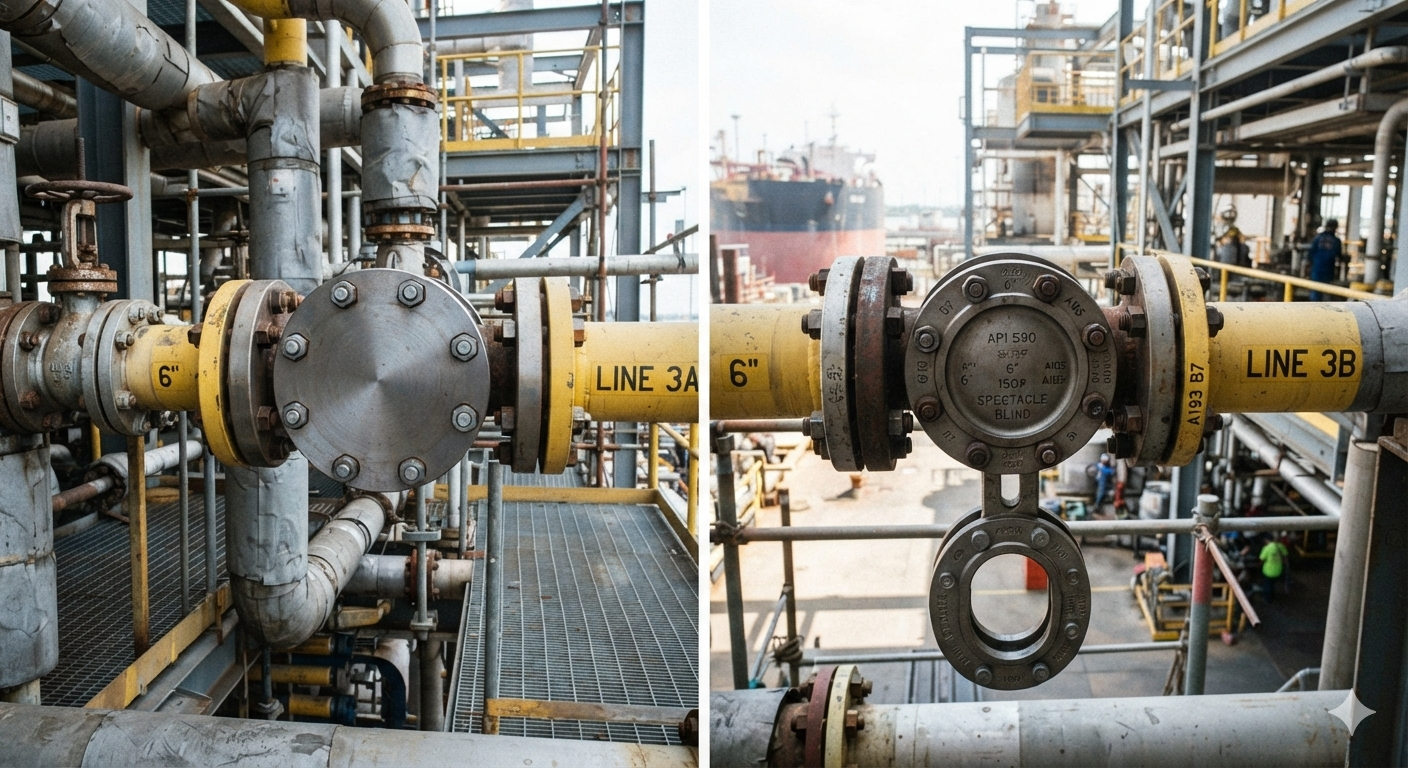
When an EPC contractor, piping engineer, procurement team, or plant maintenance professional searches for blind flange vs spectacle blind, they are usually looking for more than a simple definition. They want to know which component is suitable for the piping system, how the two products differ, which standard applies, what material should be selected, how much space is required, and what information should be included when requesting a quotation from a manufacturer or supplier.
Both products are used to achieve flow isolation, but they are not interchangeable in every application. A blind flange is a solid flanged closure, while a spectacle blind is a line blank with a solid blind portion and an open spacer portion connected together. The difference becomes particularly important when a project requires planned or repeated isolation during maintenance.
For buyers, the decision should therefore start with the application rather than the product name. Is the requirement to permanently close a pipe end or nozzle? Or does the operating team need a clearly identifiable component that can be moved between an open and isolated position? Once that question is answered, factors such as size, pressure class, facing, material, standard, gasket arrangement, inspection and documentation can be evaluated.
This guide explains blind flange vs spectacle blind from a practical engineering and procurement perspective, so you can understand what each product does and what to specify when sourcing it from a manufacturer or supplier.
When evaluating blind flange vs spectacle blind, buyers should first understand the intended function of each component. A blind flange is generally used as a solid closure for a flanged connection, while a spectacle blind is an in-line line blank designed to provide an open or isolated position. This distinction is particularly important when preparing piping specifications, material requisitions and RFQs.
What Is a Blind Flange?
A blind flange is a solid flange without a central opening for fluid flow. It is normally bolted to another flanged component to close a pipe, vessel nozzle, valve outlet, equipment connection or other flanged opening.
Unlike a weld neck or slip-on flange, a blind flange does not provide a passage through which the process fluid can travel. Its primary function is to provide a pressure-rated closure at the end of a flanged connection. ASME B16.5 covers pipe flanges and flanged fittings and specifically includes blind flanges within its scope. The 2025 edition covers pressure-temperature ratings, materials, dimensions, tolerances, marking and testing, with several pressure classes and size ranges specified by the standard.
From a buyer’s perspective, a blind flange is often selected when a connection needs to remain closed or when an equipment nozzle, pipeline end or future connection needs a bolted closure.
The important point is that the blind flange should match the mating flange and piping requirements. Nominal size alone is not enough. The buyer should consider pressure class, facing type, material grade, applicable standard, gasket arrangement and bolting requirements before placing an order.
How Does a Blind Flange Work?
A blind flange is installed against a mating flange using the appropriate gasket and bolting arrangement. Once the bolts are properly tightened, the flange creates a sealed joint that prevents process fluid from passing through the closed connection.
This makes a blind flange particularly useful for dead-end piping, equipment nozzles, temporary closures, hydrotest arrangements, future connections and selected maintenance applications. If the line needs to be reopened, however, the bolted joint has to be broken and the blind flange removed or replaced as required by the piping arrangement.
This is one of the major differences between a blind flange and a spectacle blind. A blind flange is primarily a solid flanged closure, whereas a spectacle blind is specifically designed as an in-line line blank that provides both a blank and spacer position.
What Is a Spectacle Blind?
A spectacle blind, also known as a figure-8 blind, is an in-line line blank consisting of two circular portions connected by a web. One side is a solid blank that blocks flow, while the other side is an open spacer that permits flow when positioned between the mating flanges.
The name comes from its appearance: the two circular sections connected by the web resemble a pair of spectacles.
ASME B16.48 covers operational line blanks installed between ASME B16.5 flanges. The current 2025 edition covers pressure-temperature ratings, materials, dimensions, tolerances, marking and testing for operational line blanks from NPS 1/2 through NPS 24 for installation between ASME B16.5 flanges in Classes 150, 300, 600, 900, 1500 and 2500.
The major operational advantage is that the spectacle blind can remain associated with the piping joint while being repositioned between its open and isolated positions, subject to the applicable procedure and available clearance.
That makes it particularly useful where maintenance teams need a clear, physical means of establishing line isolation at designated locations.
How Does a Spectacle Blind Work?
Imagine a pipeline that normally needs to remain open but must occasionally be isolated for equipment maintenance.
With a spectacle blind, the open spacer portion can be positioned in the flow path during normal operation. When positive physical isolation is required, the assembly can be repositioned so the solid blind portion blocks the line.
The actual installation and repositioning procedure must follow the site’s approved isolation procedure, engineering requirements and safety controls. The component is not something operators should simply rotate under pressure or without proper line depressurization and preparation.
For procurement teams, the important distinction is that a spectacle blind is designed around in-line isolation, while a conventional blind flange is generally used as a solid closure.
Blind Flange vs Spectacle Blind: What’s the Difference?
The easiest way to understand the difference is to look at the location and purpose.
A blind flange is a solid flanged closure. It is commonly used at the end of a pipe, nozzle or flanged connection.
A spectacle blind is an operational line blank installed between two mating flanges. It has both an open and a closed position.
This distinction affects the entire purchasing decision. If an EPC contractor sends an RFQ stating only “blind,” the supplier may need clarification because the project could require a blind flange, spectacle blind, paddle blind, spade, spacer or another type of line blank.
Getting this terminology correct before purchasing can prevent delays, incorrect quotations and material rejection during inspection.
Blind Flange vs Spectacle Blind Comparison
| Feature | Blind Flange | Spectacle Blind |
|---|---|---|
| Basic form | Solid circular flange | Figure-8 line blank |
| Flow opening | None | One open spacer side |
| Primary purpose | Close a flanged opening | In-line isolation and flow restoration |
| Typical position | Pipe end/nozzle/flanged connection | Between two mating flanges |
| Open/closed positions | No built-in open position | Open and blind positions |
| Common standard | ASME B16.5 | ASME B16.48 |
| Repeated isolation | Requires breaking the flange joint | Designed for repositioning |
| Visual status | Not inherently obvious | Figure-8/web provides physical indication |
| Main buyer concern | Size, class, facing, material | Size, class, facing, material, clearance |
| Typical application | End closure | Maintenance/isolation point |
| Installation | Bolted to mating flange | Installed between mating flanges |
| Handling | Relatively simple solid flange | May require clearance and handling provisions |
The standards should always be checked against the project specification. ASME B16.5 covers pipe flanges and flanged fittings, including blind flanges, while ASME B16.48 covers operational line blanks installed between ASME B16.5 flanges.
Blind Flange vs Spectacle Blind: Design and Construction
The physical design is the first difference a buyer will notice.
A blind flange resembles a conventional flange but has no central bore. It includes the flange outside diameter, bolt holes and sealing face required to connect with the mating flange.
A spectacle blind has two connected circular sections. One section is solid, and the other is an open ring. The web connecting them provides the characteristic figure-8 appearance.
This means the two products should not be treated as visually similar versions of the same component.
From a manufacturing perspective, the supplier needs to know exactly which product is required. A quotation for a blind flange cannot automatically be converted into a quotation for a spectacle blind because the dimensions, configuration, standard and installation requirements are different.
Blind Flange vs Spectacle Blind: Installation and Space Requirements
Installation is another important consideration for project engineers and maintenance teams.
A blind flange is generally straightforward when the piping arrangement provides an accessible flanged end. The flange is positioned against the mating flange with the required gasket and bolting, followed by controlled tightening according to the project’s assembly procedure.
A spectacle blind is installed between two mating flanges. Because the component needs to move between its blind and spacer positions, the piping arrangement must provide adequate clearance for safe handling and repositioning.
This point is often overlooked during procurement.
A buyer may order the correct spectacle blind according to size and class, but if the piping layout does not provide enough room for the web and blind assembly to be moved, the component may become difficult to operate during maintenance.
That is why a spectacle blind requirement should be evaluated together with the piping layout, flange spacing, operating procedure and maintenance access.
Understanding blind flange vs spectacle blind also means understanding the applicable standards. Blind flanges and operational line blanks are covered by different ASME standards, so buyers should confirm the product type and governing specification before requesting a quotation.
Blind Flange vs Spectacle Blind: Isolation and Maintenance
For maintenance applications, the distinction becomes even more important.
A blind flange can provide a strong physical barrier when installed correctly, but changing the condition of the line generally requires opening the bolted flange joint and removing or changing the closure.
A spectacle blind is designed specifically to provide an identifiable blind or open configuration at an in-line location. This can be useful where the same line needs to be isolated during planned maintenance and returned to service later.
However, neither product should be treated as a substitute for a site’s complete isolation procedure. The actual isolation method depends on the process hazard, piping design, pressure, temperature, fluid, safety procedures and applicable regulations.
For hazardous service, the engineering and operations team should determine the required isolation philosophy before the purchase order is issued.
ASME B16.5 vs ASME B16.48
This is one of the most important points for buyers.
ASME B16.5
ASME B16.5 covers pipe flanges and flanged fittings in NPS 1/2 through NPS 24. It addresses pressure-temperature ratings, materials, dimensions, tolerances, marking, testing and flange joint requirements. The standard includes blind flanges among the flange types covered.
ASME B16.48
ASME B16.48 covers line blanks, including operational configurations used between ASME B16.5 flanges. The 2025 edition covers NPS 1/2 through NPS 24 and Classes 150 through 2500 within its stated scope.
| Standard | Main Product Scope | Buyer Relevance |
|---|---|---|
| ASME B16.5 | Pipe flanges and flanged fittings | Blind flanges and mating flange requirements |
| ASME B16.48 | Operational line blanks | Spectacle blinds and other line blank configurations |
Understanding blind flange vs spectacle blind also requires attention to the applicable ASME standard. Blind flanges are covered within the scope of ASME B16.5, while operational line blanks are covered by ASME B16.48. Buyers should therefore identify the required product and applicable standard clearly in the technical specification.
For an RFQ, the applicable standard should be stated clearly rather than leaving the supplier to make assumptions.
Pressure Class and Size Selection
The pressure class is one of the first details a manufacturer will look for when reviewing an enquiry.
For blind flanges, the applicable ASME B16.5 class and size determine important dimensional and pressure-temperature requirements. ASME B16.5 includes Classes 150, 300, 400, 600, 900 and 1500 in NPS 1/2 through NPS 24, with Class 2500 covered up to NPS 12 under the standard’s stated scope. (ASME)
For spectacle blinds and other line blanks, ASME B16.48 defines its own scope and dimensional requirements.
The buyer should therefore avoid specifying something like:
“12-inch blind, 300 class.”
Instead, the RFQ should identify whether the requirement is a blind flange or spectacle blind, together with the applicable standard, material, facing and quantity.
That small amount of additional information can make a major difference to quotation accuracy.
Material Selection for Blind Flanges and Spectacle Blinds
Material selection should be based on the process fluid, temperature, pressure, corrosion conditions and project material specification.
For Jade Special Metals, this is also an opportunity to demonstrate expertise in specialty metallurgy rather than presenting flanges as commodity products.
Carbon Steel
Carbon steel blind flanges and line blanks are widely considered for general industrial, oil and gas, utility and process applications where the service environment permits carbon steel.
The exact material grade should follow the approved material specification rather than simply stating “carbon steel.”
Stainless Steel
Stainless steel is selected when improved corrosion resistance is required.
Common grades such as 304/304L and 316/316L are used across chemical, process, water and general industrial applications.
Alloy Steel
Alloy steel can be selected for elevated-temperature and demanding mechanical-service conditions, including applications within refinery and power-generation environments.
The correct grade depends on the design conditions and applicable material specification.
Duplex Steel
Duplex stainless steel combines high strength with corrosion resistance and is considered for demanding process, offshore, chemical and marine applications.
Super Duplex Steel
Super duplex steel is particularly relevant where chloride resistance, strength and seawater performance are important.
This makes it relevant to offshore, desalination and marine projects.
Nickel Alloys
Nickel alloy blind flanges and spectacle blinds can be selected for highly corrosive or high-temperature services where conventional stainless steels may not provide the required performance.
Monel Alloy
Monel is a nickel-copper alloy family used in selected marine and chemical environments.
The exact grade should be specified according to the process conditions.
Alloy 20
Alloy 20 is used in selected chemical applications where corrosion resistance to aggressive media is required.
Inconel Alloy
Inconel alloys are used for demanding combinations of high temperature, oxidation and corrosion resistance.
The specific grade should always be confirmed rather than specifying only “Inconel.”
Hastelloy Alloy
Hastelloy alloys are considered for severe chemical environments where high corrosion resistance is critical.
Titanium Alloy
Titanium is highly relevant to seawater, desalination and specialized chemical applications where exceptional corrosion resistance is required.
Copper Nickel
Copper nickel alloys are commonly associated with marine and seawater service and can be considered for offshore and shipboard piping systems.
Material Selection Comparison
| Material | Main Advantage | Typical Applications |
|---|---|---|
| Carbon Steel | Strength and economy | Oil & gas, utilities |
| Stainless Steel | Corrosion resistance | Chemical, process, water |
| Alloy Steel | High-temperature performance | Refinery, power |
| Duplex Steel | Strength + corrosion resistance | Oil & gas, marine |
| Super Duplex Steel | Chloride resistance + strength | Offshore, desalination |
| Nickel Alloy | Severe corrosion resistance | Chemical processing |
| Monel Alloy | Marine/chemical resistance | Marine, chemical |
| Alloy 20 | Chemical corrosion resistance | Chemical plants |
| Inconel Alloy | High-temperature resistance | Power, process |
| Hastelloy Alloy | Severe chemical resistance | Chemical processing |
| Titanium Alloy | Exceptional corrosion resistance | Desalination, seawater |
| Copper Nickel | Seawater performance | Marine, offshore |
Material selection is another important part of the blind flange vs spectacle blind evaluation. Depending on the service environment, buyers may require carbon steel, stainless steel, duplex, super duplex, nickel alloys, titanium or other specialty materials. The selected material should be based on process conditions and the approved project material specification.
In refinery and petrochemical applications, the blind flange vs spectacle blind decision can have a direct impact on maintenance planning and line isolation. Blind flanges are commonly used where a flanged connection needs to be closed, while spectacle blinds can be specified at designated isolation points within process piping. The final selection should always follow the approved piping class, isolation philosophy and project specification.
Where Are Blind Flanges Used?
Blind flanges are used across many industrial applications.
In oil and gas facilities, they can be used for pipeline ends, equipment nozzles, temporary closures and selected maintenance arrangements.
In petrochemical plants, blind flanges may be specified for equipment connections and piping systems requiring a pressure-rated bolted closure.
In chemical plants, material selection becomes particularly important because the flange may be exposed to aggressive process media.
In power plants, blind flanges can be used across steam, water, cooling and utility systems according to the applicable piping design.
In water treatment and desalination, stainless steel, duplex, super duplex, titanium and copper-nickel materials may be considered depending on water chemistry and service conditions.
Where Are Spectacle Blinds Used?
Spectacle blinds are particularly useful where a line requires a designated isolation point that can be switched between open and blind conditions.
Typical applications can include:
- Oil and gas facilities
- Refineries
- Petrochemical plants
- Chemical processing plants
- Power-generation facilities
- Offshore platforms
- Marine systems
- Water and desalination facilities
- Process equipment isolation
- Maintenance and turnaround operations
The exact application should be determined by the plant’s isolation philosophy and engineering requirements.
A spectacle blind can be especially valuable at locations where maintenance teams need a clear physical indication that the line is positively blanked, subject to the site’s procedures.
Which Is Better: Blind Flange or Spectacle Blind?
There is no universal winner.
If you need to close the end of a pipe or equipment nozzle, a blind flange may be the appropriate solution.
If you need an in-line isolation device that provides both an open and blind position, a spectacle blind may be more appropriate.
The selection should therefore be based on:
Application → Isolation requirement → Piping arrangement → Size → Pressure class → Material → Facing → Standard → Maintenance requirements → Inspection requirements
This is a much better selection process than asking which product is “stronger” or “better.”
The two products are designed for different purposes.
When requesting pricing for blind flange vs spectacle blind requirements, providing complete technical information allows the manufacturer or supplier to prepare a more accurate quotation. Size, pressure class, material grade, facing, applicable standard, quantity and inspection requirements should be clearly stated wherever applicable.
For buyers, the blind flange vs spectacle blind decision should be made before sending an RFQ to a manufacturer or supplier. Clearly identifying the required component helps avoid assumptions about dimensions, standards, pressure class and material. If the project documentation specifies a particular line blank configuration, the supplier should quote according to that requirement rather than automatically substituting a conventional blind flange.
What Should Buyers Include in a Blind Flange RFQ?
If you are purchasing from a manufacturer or supplier, your enquiry should be as specific as possible.
A good blind flange RFQ should include:
- Product: Blind Flange
- Nominal pipe size
- Pressure class
- Material grade
- Applicable standard
- Facing type
- Quantity
- Schedule/wall thickness of mating pipe where relevant
- Gasket requirement
- Bolting requirement, if included in supply
- Inspection requirement
- MTC requirement
- Third-party inspection requirement
- Delivery location
- Required delivery date
For example:
Blind Flange, NPS 8, Class 600, ASTM A182 F316L, ASME B16.5, RF, Qty 20 Nos., MTC required, delivery to Mumbai.
The actual specification should always be checked against the project’s approved datasheet and piping class.
What Should Buyers Include in a Spectacle Blind RFQ?
A spectacle blind enquiry should be even more specific because it is an in-line line blank.
Include:
- Spectacle blind / figure-8 blind
- Nominal pipe size
- Pressure class
- Material grade
- Applicable standard
- Facing requirement
- Bore requirement
- Thickness requirement where specified
- Quantity
- Service
- Mating flange standard
- Inspection requirements
- MTC
- PMI, if required
- Third-party inspection, if required
- Delivery location
- Required delivery date
For a project enquiry, attaching the line list, piping class, datasheet or relevant drawing can make the quotation process significantly easier.
Quality and Documentation Buyers Should Ask For
A low-price quotation is not necessarily the best industrial purchase.
For critical piping components, buyers may need documentation supporting material identity, dimensional compliance and inspection.
Depending on the project specification, buyers may request:
- Material Test Certificate (MTC)
- Heat number traceability
- Dimensional inspection report
- PMI report
- Hardness report where specified
- NDE documentation where applicable
- Certificate of conformity
- Inspection release note
- Third-party inspection
- Country of origin documentation
- Packing list
- Commercial documentation
Not every project requires every document. The correct documentation should be agreed in the purchase specification before manufacturing begins.
This is especially important for duplex, super duplex, nickel alloys, titanium and other specialty materials, where traceability and material verification can be critical.
Common Buyer Mistakes
One of the most common mistakes is ordering a component using only its nominal size.
For example, saying:
“Need 10-inch blind.”
does not tell the supplier enough.
The supplier needs to know whether you mean a blind flange or a line blind, what pressure class is required, which material should be used and which standard governs the product.
Another mistake is confusing spectacle blind with blind flange. They are both associated with isolation, but their installation and operating functions are different.
A third mistake is forgetting the facing type. RF, FF and RTJ requirements can affect the product configuration and mating arrangement.
Another common issue is requesting specialty metallurgy without identifying the exact grade. “Nickel alloy” or “duplex” is not a complete material specification.
Finally, some buyers ask for pricing before checking the project documentation requirements. If MTC, PMI, third-party inspection or special testing is required, it should be included in the RFQ.
The blind flange vs spectacle blind decision should be based on how the piping system needs to operate. If the requirement is to close a flanged connection, a blind flange may be appropriate. If the piping system requires a designated in-line isolation point that can be changed between an open and blind position, a spectacle blind may be the better choice.
Before requesting pricing for blind flange vs spectacle blind requirements, buyers should provide enough technical information for the manufacturer to identify the correct product. Nominal size and quantity alone are rarely sufficient for a project-quality quotation. The supplier may need the pressure class, material grade, facing, applicable standard, service conditions, inspection requirements and delivery information.
Blind Flange vs Spectacle Blind: Buyer Selection Guide
| Your Requirement | More Suitable Starting Point |
|---|---|
| Close a pipe end | Blind Flange |
| Close an equipment nozzle | Blind Flange |
| Permanent flanged closure | Blind Flange |
| In-line isolation point | Spectacle Blind |
| Need open and blind positions | Spectacle Blind |
| Planned maintenance isolation | Spectacle Blind |
| Frequent isolation changes | Spectacle Blind |
| Requirement specifically states ASME B16.5 blind flange | Blind Flange |
| Requirement specifically states ASME B16.48 line blank | Spectacle Blind / applicable line blank |
| Need a figure-8 configuration | Spectacle Blind |
This is a selection guide, not a replacement for the project’s engineering specification, process safety requirements or approved piping class.
Why Supplier Capability Matters
For industrial buyers, the supplier’s capability can be just as important as the product itself.
A supplier should understand the difference between blind flanges, spectacle blinds, spades, spacers and other line blank configurations and should be able to review the technical requirement before quoting.
This becomes even more important when the requirement involves specialty metallurgy.
For example, a buyer ordering a super duplex spectacle blind is not simply purchasing a piece of steel in a particular shape. The project may require a specific UNS grade, heat treatment, material certification, PMI, dimensional inspection and third-party inspection.
The supplier therefore needs to manage the product from material selection through manufacturing, inspection, traceability and delivery.
For EPC and industrial buyers, this reduces the risk of receiving a component that is dimensionally correct but technically unacceptable for the project.
Why Choose Jade Special Metals?
For Jade Special Metals, this article should lead naturally into the company’s capability rather than turning into an aggressive sales pitch.
The focus should be on helping buyers source the right flange or line blank for their application.
Jade Special Metals can position its product capability around industrial requirements involving carbon steel, stainless steel, alloy steel, duplex steel, super duplex steel, nickel alloys, Monel, Alloy 20, Inconel, Hastelloy, titanium and copper nickel, subject to the applicable product specification and grade.
For a quotation, buyers should provide the available datasheet, piping class, material requisition, flange schedule, drawing or line list. Supplying this information allows the manufacturer or supplier to evaluate the requirement accurately instead of making assumptions.
That is particularly valuable for EPC projects, shutdown requirements, export orders and specialty-alloy applications where technical compliance and documentation are important.
Final Thoughts
Understanding blind flange vs spectacle blind is important because the two products solve different piping requirements.
A blind flange is a solid flanged closure used to close a pipe, nozzle or flanged connection. A spectacle blind is an operational line blank consisting of a blind portion and an open spacer portion, designed for use between mating flanges where controlled isolation and restoration of flow are required.
For buyers, the selection should not be based only on price or appearance. The correct product depends on the piping arrangement, isolation philosophy, nominal size, pressure class, material, facing, applicable standard, maintenance requirements and inspection documentation.
ASME B16.5 provides requirements for pipe flanges and flanged fittings, including blind flanges, while ASME B16.48 covers operational line blanks installed between ASME B16.5 flanges.
If you are preparing an RFQ, clearly state whether you require a blind flange or spectacle blind, along with the size, class, material grade, facing, standard, quantity and documentation requirements.
Ultimately, the blind flange vs spectacle blind choice depends on the purpose of the piping connection. A blind flange is generally appropriate for a solid flanged closure, while a spectacle blind is intended for an in-line line-blank arrangement. Reviewing the application, standard, material and maintenance requirements before purchasing helps buyers select the correct component.
For specialty-material applications, working with a supplier that understands stainless steel, duplex, super duplex, nickel alloys, titanium and other corrosion-resistant materials can help prevent specification errors and reduce procurement risk.
The best component is not simply the one that fits the pipe. It is the one that fits the engineering requirement, operating philosophy and project specification.
Frequently Asked Questions
What is the difference between a blind flange and a spectacle blind?
The primary difference in blind flange vs spectacle blind selection is their design and installation. A blind flange is a solid flanged closure, whereas a spectacle blind is an operational line blank with a blind section and an open spacer section.
Is a spectacle blind the same as a blind flange?
No. They have different designs and applications. A blind flange is generally used to close a flanged opening, while a spectacle blind is an in-line line blank that can provide either an open or isolated configuration.
Which standard covers blind flanges?
Blind flanges fall within the scope of ASME B16.5, which covers pipe flanges and flanged fittings and includes requirements for ratings, materials, dimensions, tolerances, marking and testing.
Which standard covers spectacle blinds?
ASME B16.48 covers operational line blanks. Its 2025 scope covers line blanks from NPS 1/2 through NPS 24 for installation between ASME B16.5 flanges in Classes 150, 300, 600, 900, 1500 and 2500.
Which is better for maintenance isolation?
A spectacle blind can be advantageous where the piping system requires a designated in-line isolation point that can be changed between open and blind positions. The final selection must follow the plant’s approved isolation procedure and engineering requirements.
Can a blind flange replace a spectacle blind?
Not automatically. They have different installation arrangements and functions. If the project specifically requires an operational line blank or spectacle blind, substituting a conventional blind flange should be approved by the responsible engineering authority.
What materials are available for spectacle blinds?
Depending on the applicable specification and manufacturer capability, spectacle blinds can be supplied in materials such as carbon steel, stainless steel, alloy steel, duplex, super duplex, nickel alloys, Monel, Alloy 20, Inconel, Hastelloy, titanium and copper nickel.
What information should I send when requesting a quotation?
Provide the product type, nominal size, pressure class, material grade, applicable standard, facing, quantity, service, inspection requirements and delivery location. For project orders, attaching the relevant piping class, datasheet or drawing is strongly recommended.
Are spectacle blinds used in oil and gas plants?
Yes. Spectacle blinds and other line blanks are used in industrial piping systems where designated physical isolation is required. Their suitability depends on the process design, isolation philosophy and applicable project specification.
Which is better, a blind flange or spectacle blind?
There is no universal answer to the blind flange vs spectacle blind question. A blind flange is generally suited to closing a flanged opening, while a spectacle blind is useful where an in-line piping system requires a designated open and isolated configuration.