
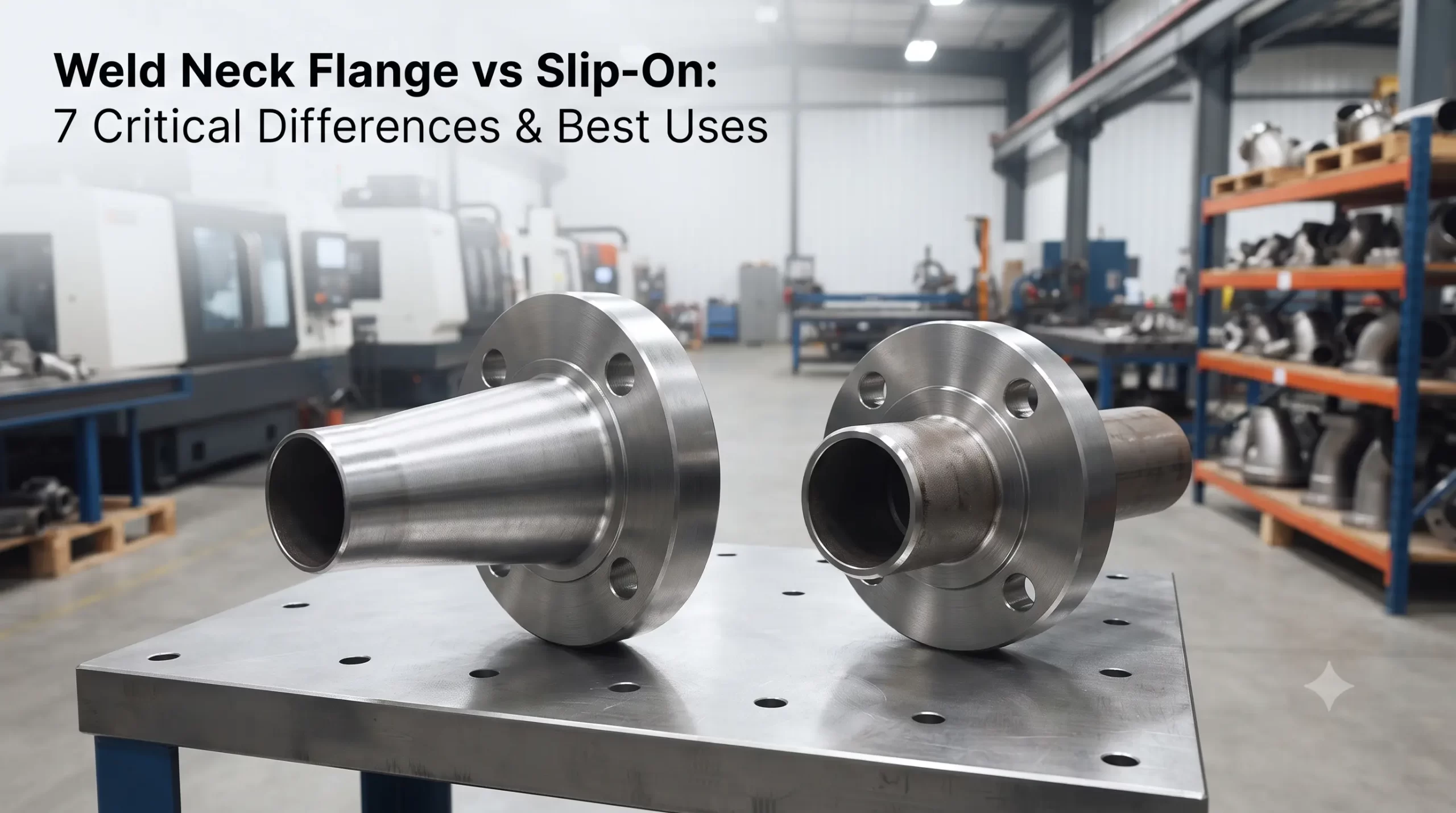
Selecting the right flange is not simply a matter of choosing a component that fits the pipe. In an industrial piping system, the flange connection has to work with the pipe, gasket, bolts, welding procedure, operating conditions and the equipment connected to it. This is why the choice between a weld neck flange and a slip-on flange deserves careful consideration, particularly when the piping system operates under pressure, temperature changes, vibration or repeated loading.
At first glance, these two flange types can look quite similar. Both are widely used for connecting pipes to valves, equipment and other piping components, and both are covered by established flange standards. However, their geometry and method of attachment are different. A weld neck design uses a tapered hub and butt-weld connection, while a slip-on design slides over the pipe and is normally secured with fillet welds.
So, which one is better?
There is no universal answer. A weld neck flange is generally the stronger choice for demanding pressure, temperature and cyclic applications, while a slip-on flange can be a practical and economical option for many less demanding services. The correct decision depends on the piping class, service conditions, material, fabrication requirements and project specification.
This guide from Jade Special Metals explains the difference between these two common industrial flange types, including design, welding, strength, applications, materials, standards, advantages, limitations and selection considerations.
What Is a Weld Neck Flange?
A weld neck flange, commonly abbreviated as WN flange, is a flanged connection with a long, tapered hub that connects to the pipe through a butt weld. The tapered hub is one of its defining characteristics because it provides a gradual transition between the flange body and the pipe.
Unlike a flat flange that simply slips over the pipe, the weld neck design is engineered to transfer stresses more gradually through the hub and into the pipe wall. The pipe bore and flange bore are also matched according to the required pipe schedule and specification.
During fabrication, the pipe end is prepared for butt welding and aligned with the flange hub. The resulting welded joint becomes an important part of the pressure boundary. Because the connection is a butt-welded arrangement, the welding procedure and inspection requirements can be more involved than those associated with a typical slip-on connection.
This makes the weld neck flange particularly attractive for process lines where pressure, temperature, vibration or cyclic loading needs to be considered.
What Is a Slip-On Flange?
A slip-on flange is designed with a bore that allows the flange to slide over the outside diameter of the pipe. Once positioned, the flange is welded to the pipe, commonly using fillet welds on the outside and inside of the connection according to the applicable design and fabrication requirements.
The biggest practical advantage of the slip-on design is its relatively simple installation. The flange can be positioned over the pipe before welding, making fit-up and alignment convenient for many applications. This can reduce fabrication complexity compared with a butt-welded hub connection.
Slip-on flanges are commonly considered for utility lines, water services, air systems and other applications where the operating conditions are not as demanding as those found in severe process or high-cycle services.
That does not mean a slip-on flange is an inferior component. It means that its design offers a different balance between performance, fabrication simplicity and cost.
Weld Neck Flange vs Slip-On Flange: Basic Difference
The fundamental difference between a weld neck flange and a slip-on flange is how the flange transfers loads to the pipe.
A weld neck flange has a tapered hub and connects through a butt weld. The hub creates a gradual transition between the flange and pipe, which helps reduce abrupt stress changes.
A slip-on flange has a comparatively simple body that fits over the pipe. The connection is completed with fillet welds. This arrangement can be easier and faster to fabricate, but its structural behaviour differs from a tapered-hub butt-weld connection.
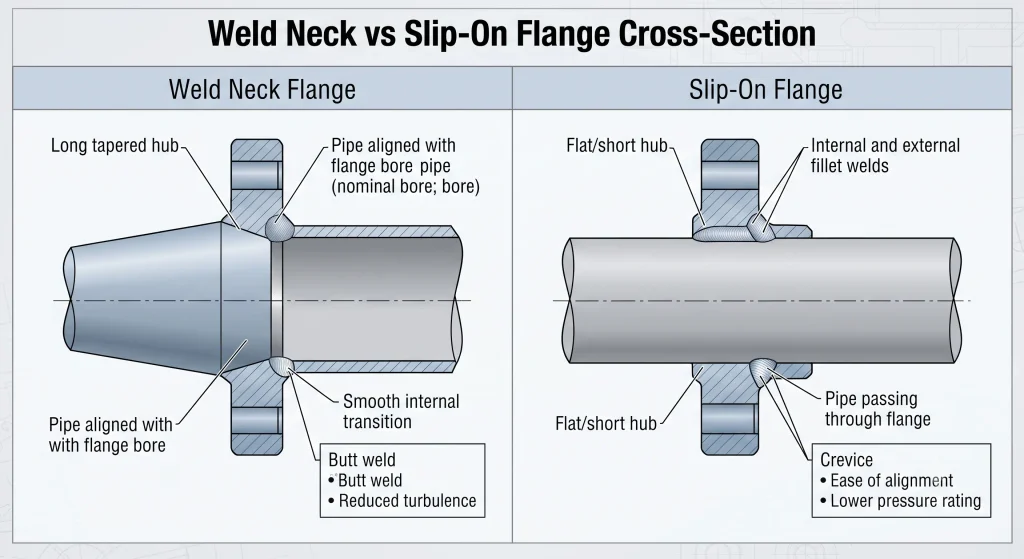
The two flange types can be manufactured for many of the same nominal pipe sizes and materials, but that does not make them automatically interchangeable. Engineering requirements, piping class and project specifications determine whether one type is permitted.
| Feature | Weld Neck Flange | Slip-On Flange |
|---|---|---|
| Common abbreviation | WN | SO |
| Hub | Long tapered hub | Short/flat configuration |
| Pipe connection | Butt weld | Fillet welds |
| Fit-up | More precise | Generally easier |
| Fabrication | More involved | Simpler |
| Stress distribution | Excellent for demanding service | Suitable for less severe service |
| Cyclic loading | Better suited | More limited |
| Initial cost | Generally higher | Generally lower |
| Typical applications | Critical process and high-stress piping | Utilities and general service |
| Common standard | ASME B16.5 | ASME B16.5 |
7 Critical Differences Between Weld Neck and Slip-On Flanges
Understanding the following differences makes flange selection much easier. Rather than asking which flange is always better, engineers should ask which design is better for the specific piping service.
1. Flange Design and Geometry
The geometry of the weld neck flange is its biggest structural advantage. The long tapered hub creates a gradual transition from the flange to the pipe, helping distribute mechanical loads over a larger area.
A slip-on flange has a much simpler shape. The pipe passes through the flange bore and the flange is positioned at the required location before welding.
Why does this matter? Imagine bending a metal sheet sharply at one point versus gradually curving it. The abrupt change tends to concentrate stress, while a gradual transition distributes the load more smoothly. The tapered hub of a weld neck design follows this general engineering principle.
For systems exposed to thermal expansion, vibration, pressure fluctuations or repeated mechanical loading, this difference can become particularly important.
2. Welding Method
A weld neck flange is normally connected to the pipe using a butt weld at the end of its tapered hub. This requires suitable pipe-end preparation, alignment and welding control.
A slip-on flange is installed over the pipe and welded into position. The connection commonly uses fillet welds around the pipe and flange.
The two welding arrangements require different fabrication procedures. A butt weld generally demands more precise preparation and fit-up, while a slip-on connection can be easier to position before welding.
For critical piping, the welding procedure should be established according to the applicable material, piping code and project requirements rather than choosing a connection simply because it appears easier to fabricate.
3. Strength and Stress Distribution
A weld neck flange is generally preferred when the piping system experiences significant mechanical or thermal stresses. Its tapered hub provides a more gradual transition between the flange and pipe.
Slip-on flanges can perform reliably in suitable services, but the connection geometry is less optimized for severe cyclic loading.
This is particularly relevant in systems where the pipe repeatedly expands and contracts because of temperature changes. Repeated stress cycles can eventually become more important than the static pressure alone.
That is why flange selection should consider not only the design pressure but also temperature fluctuations, vibration, external loads, thermal expansion and other mechanical conditions.
4. Fatigue and Cyclic Service
Fatigue is one of the areas where the difference between these flange designs becomes especially important.
A piping system may experience thousands of operating cycles during its lifetime. Start-ups, shutdowns, thermal changes, pressure fluctuations, compressor vibration and equipment movement can all create repeated loads.
The tapered hub of a weld neck flange provides a smoother stress transition than the simpler geometry of a slip-on flange. As a result, weld neck designs are generally preferred for demanding cyclic applications.
Slip-on flanges can still be appropriate where cyclic stresses are low and the piping specification permits their use.
The key lesson is simple: static pressure is not the only design consideration. A flange that works well in a stable utility system may not be the right choice for a highly cyclic process line.
5. Installation and Fabrication
Slip-on flanges have a practical advantage during installation. Because the flange slides over the pipe, it can be positioned and rotated before welding. This can make fit-up easier for fabrication teams.
A weld neck flange requires more accurate alignment because the pipe end must be properly prepared and fitted to the flange hub for the butt weld.
However, easier installation does not automatically mean better performance. Industrial piping is a balance between fabrication efficiency and long-term reliability.
For critical services, the additional preparation associated with a weld neck flange may be justified by its structural and fatigue advantages.
6. Cost
Slip-on flanges are generally more economical than weld neck flanges because their geometry is simpler and installation can be less demanding.
A weld neck flange normally involves additional manufacturing complexity and more precise fabrication. The pipe also requires suitable end preparation for the butt weld.
But comparing only the purchase price can be misleading.
Total project cost may include flange price, welding labour, consumables, inspection, NDE, fabrication time, documentation and potential maintenance. A slightly more expensive flange can be the better economic choice if it reduces risk in a critical service.
For this reason, lifecycle cost should be considered alongside purchase price.
7. Inspection and Maintenance Considerations
Inspection requirements depend on the applicable piping code, project specification, material and service classification.
The butt-welded connection associated with a weld neck flange can be examined using applicable volumetric or surface NDE methods where required. Slip-on flange connections use fillet welds, and the applicable inspection approach may differ.
This does not mean that every weld neck flange requires radiography or that every slip-on flange cannot be inspected volumetrically. Inspection requirements are determined by the governing engineering documents.
For critical services, it is therefore important to establish the inspection plan before procurement and fabrication.
Applications of Weld Neck Flanges
Weld neck flanges are commonly selected for demanding industrial piping applications where mechanical integrity and resistance to stress are important.
Typical applications include oil and gas process systems, refineries, petrochemical plants, power generation facilities, chemical processing plants and high-temperature piping.
They are also suitable for systems where pressure fluctuations, vibration or thermal cycling are expected. The tapered hub provides a gradual transition between the flange and pipe, making the design well suited to demanding service conditions.
For example, a high-temperature process line may repeatedly expand during plant operation and contract during shutdown. The resulting thermal movement can place additional stress on piping connections. In such circumstances, the robust geometry of a weld neck design can provide an important engineering advantage.
The final flange selection should always follow the piping class, applicable code and project specification.
Applications of Slip-On Flanges
Slip-on flanges are often selected when installation simplicity and cost efficiency are important and the service conditions allow their use.
Common applications include utility water lines, compressed-air systems, cooling-water systems, general service piping and selected low- or moderate-severity process applications.
Their ability to slide over the pipe can simplify alignment and fabrication. This is particularly useful when a project contains a large number of flange connections and the operating conditions do not justify the additional fabrication requirements associated with weld neck designs.
However, “lower severity” should not be interpreted as a fixed pressure limit. The suitability of a slip-on flange depends on the actual pressure-temperature rating, material, piping code and project specification.
Weld Neck vs Slip-On Flange: Material Selection
Flange material is just as important as flange type. The selected material must be compatible with the process fluid, pressure, temperature, corrosion environment and mechanical requirements.
At Jade Special Metals, industrial flange applications can involve a wide range of metallurgy, from conventional carbon steel and stainless steel to duplex, super duplex, nickel alloys, titanium and copper nickel.
Stainless Steel Flanges
Stainless steel flanges are widely used where corrosion resistance and mechanical performance are required. Common grades include 304/304L and 316/316L.
316/316L is frequently considered for applications where greater resistance to many chloride-containing environments is required compared with 304/304L.
Stainless steel flanges are used in chemical processing, pharmaceutical, food processing, water treatment, petrochemical and general industrial applications.
Carbon Steel Flanges
Carbon steel flanges are a common choice for general industrial piping because they offer good mechanical strength and cost efficiency.
They are frequently used in water, hydrocarbons, air, steam and utility services where the process environment does not require the corrosion resistance of stainless or nickel alloys.
Appropriate corrosion allowances, coatings or other protective measures may be required depending on the service.
Alloy Steel Flanges
Alloy steel flanges are used where enhanced mechanical properties and high-temperature performance are required.
Chromium-molybdenum alloy steels are commonly associated with refinery, petrochemical and power-generation applications involving elevated temperatures.
The correct grade should be selected according to the design temperature, pressure, mechanical requirements and applicable material specification.
Duplex Steel Flanges
Duplex steel flanges combine austenitic and ferritic phases, offering a useful balance of strength and corrosion resistance.
Grades such as UNS S31803 and UNS S32205 are considered for demanding services including oil and gas, chemical processing, marine systems and desalination.
Manufacturing and welding need appropriate control to maintain the required metallurgical structure.
Super Duplex Steel Flanges
Super duplex steel flanges provide high strength and strong resistance to localized corrosion, particularly in demanding chloride-containing environments.
UNS S32750 and UNS S32760 are widely recognized grades in this material family.
Applications include offshore systems, seawater service, desalination, chemical processing and oil and gas facilities.
Nickel Alloy Flanges
Nickel alloy flanges are selected for severe corrosion and temperature environments where conventional steels may not provide sufficient performance.
The nickel alloy family includes materials such as Monel, Inconel, Hastelloy and Alloy 20. These alloys are not interchangeable, and the correct grade must be selected according to the actual process conditions.
Monel Alloy Flanges
Monel alloy flanges, particularly Monel 400, are nickel-copper materials valued for corrosion resistance and mechanical strength.
They can be considered for marine, seawater and selected chemical-processing applications.
The exact grade and operating environment must be evaluated before material selection.
Alloy 20 Flanges
Alloy 20 flanges are used in applications where resistance to aggressive chemical environments is required.
The material is particularly associated with sulfuric-acid service, although actual suitability depends on acid concentration, temperature and other process conditions.
Inconel Alloy Flanges
Inconel alloy flanges are nickel-chromium-based materials used for demanding high-temperature and corrosion-resistant applications.
Different grades such as Inconel 600, 625 and 718 offer different combinations of properties and should be selected according to the specific application.
Hastelloy Alloy Flanges
Hastelloy alloy flanges are used in severe chemical environments where high corrosion resistance is required.
Hastelloy C-276 is one well-known grade, but the Hastelloy family contains several different alloys designed for different service conditions.
Titanium Alloy Flanges
Titanium alloy flanges offer excellent corrosion resistance combined with relatively low density.
They can be considered for seawater, desalination, chemical processing and other specialized applications where titanium’s corrosion resistance provides an advantage.
Copper Nickel Flanges
Copper nickel flanges are particularly useful in marine and seawater applications.
Common Cu-Ni compositions include 90/10 and 70/30 copper nickel. These materials are valued for their resistance to seawater corrosion and are used in marine piping, offshore systems, shipbuilding and seawater cooling applications.
Flange Material Comparison Table
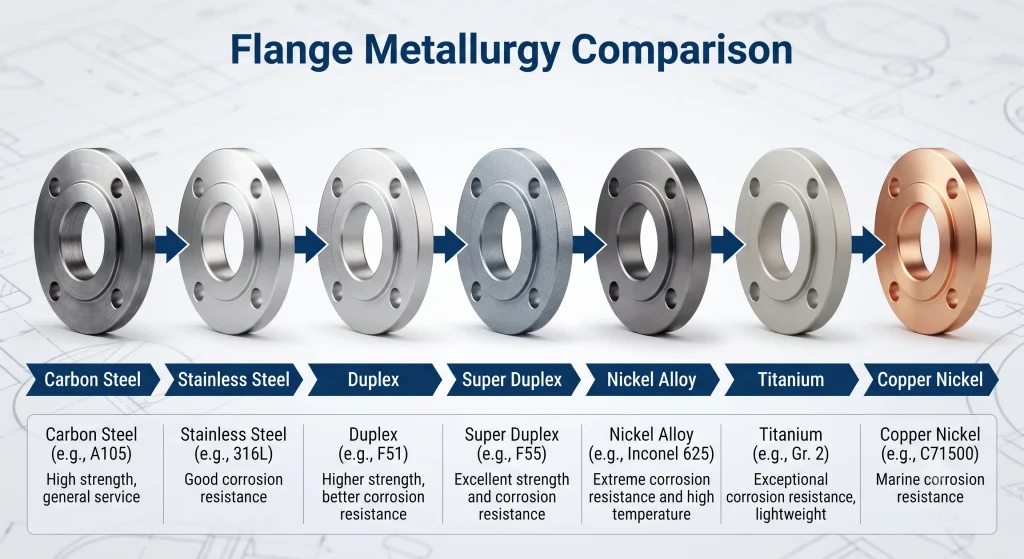
| Material | Main Advantage | Typical Applications |
| Carbon Steel | Strength and cost efficiency | Utilities, hydrocarbons, general piping |
| Stainless Steel | Corrosion resistance | Chemical, food, pharma, water |
| Alloy Steel | High-temperature performance | Power, refinery, petrochemical |
| Duplex Steel | Strength + corrosion resistance | Oil & gas, marine, desalination |
| Super Duplex Steel | High strength + chloride resistance | Offshore, seawater, chemical |
| Nickel Alloy | Severe-service corrosion resistance | Chemical and process industries |
| Monel | Nickel-copper corrosion resistance | Marine and chemical service |
| Alloy 20 | Acid corrosion resistance | Chemical processing |
| Inconel | High-temperature performance | Power, chemical, oil & gas |
| Hastelloy | Severe corrosion resistance | Chemical processing |
| Titanium | Excellent corrosion resistance | Marine, desalination, chemical |
| Copper Nickel | Seawater resistance | Marine, offshore, cooling |
Weld Neck vs Slip-On Flange Comparison Table
| Parameter | Weld Neck Flange | Slip-On Flange |
| Design | Tapered hub | Simple flange body |
| Connection | Butt weld | Fillet weld |
| Fit-up | More precise | Easier |
| Fabrication | More involved | Simpler |
| Stress distribution | Excellent | Suitable for less demanding service |
| Cyclic service | Generally preferred | More limited |
| Installation | Requires careful preparation | Relatively easy |
| Cost | Higher | Lower |
| Typical service | Critical process piping | Utility/general service |
| Material options | Broad | Broad |
| Selection | Based on demanding service requirements | Based on suitable lower-severity service |
It is important not to interpret this table as a replacement for engineering calculations. Both flange types are manufactured to defined standards and pressure-temperature ratings. The actual selection must consider the complete piping system.
Which Is Better: Weld Neck or Slip-On Flange?
If the question is simply, “Which is better?”, the technically responsible answer is: it depends on the application.
A weld neck flange is generally the preferred choice when the piping system involves high mechanical loads, significant thermal cycling, vibration, demanding process conditions or other circumstances where a robust butt-welded connection is desirable.
A slip-on flange may be the better choice when the service is less demanding and the project prioritizes simpler fabrication and lower cost.
Think of it like choosing between a heavy-duty industrial vehicle and a compact utility vehicle. The heavy-duty option offers greater capability, but using it everywhere would not necessarily be economical. The compact option can be perfectly appropriate when the operating conditions do not demand additional capacity.
The same logic applies to flange selection.
When Should You Choose a Weld Neck Flange?
A weld neck flange should be strongly considered when the system involves demanding pressure or temperature conditions, cyclic loading, vibration, critical process service or stringent inspection requirements.
It is particularly attractive where stress concentration and fatigue are important design considerations.
Typical examples include:
- High-pressure process piping
- High-temperature piping
- Steam systems
- Oil and gas process lines
- Refinery process piping
- Petrochemical facilities
- Critical chemical services
- Piping subject to thermal cycling
- Systems with significant vibration or mechanical loading
The governing piping specification should always confirm whether weld neck construction is required.
When Is a Slip-On Flange a Good Choice?
A slip-on flange can be a practical solution when the piping service is relatively stable and the applicable specification permits the use of slip-on construction.
Typical examples can include utility water, compressed air, cooling water, drains and selected general-service lines.
The major benefits are fabrication simplicity, convenient alignment and generally lower initial cost.
However, engineers should not select slip-on flanges purely because they are cheaper. Pressure, temperature, corrosion, vibration, cyclic loading, inspection and service criticality still need to be evaluated.
ASME B16.5 and Flange Standards
For many industrial flange applications, ASME B16.5 is a key reference. The current ASME listing is B16.5-2025, covering pipe flanges and flanged fittings from NPS 1/2 through NPS 24. It addresses pressure-temperature ratings, materials, dimensions, tolerances, marking, testing and flange-related requirements.
ASME B16.5 includes pressure class designations such as 150, 300, 400, 600, 900 and 1500 for specified sizes, with Class 2500 covered for certain sizes. It also includes requirements related to flange bolting, gaskets and flange joints.
For larger flange sizes, other standards such as ASME B16.47 may become applicable depending on the project.
For process piping, the governing piping code should also be considered because flange selection is part of the overall piping design rather than an isolated component decision.
Jade Special Metals recommends checking the applicable standard edition, project specification, material specification and pressure-temperature requirements before finalizing a flange purchase.
Common Mistakes When Selecting Flanges
One common mistake is selecting a flange based only on nominal size and pressure class. Two flanges may have the same nominal size and class but still be inappropriate for the same application because their connection design, material and service requirements differ.
Another mistake is focusing entirely on purchase price. A cheaper flange can require different fabrication procedures or may not be suitable for a demanding service.
Material selection is another frequent problem. Stainless steel, duplex, super duplex and nickel alloys are not interchangeable simply because they are all corrosion-resistant materials.
Ignoring thermal cycling is also risky. A line that operates at a stable temperature may behave very differently from a line that repeatedly heats and cools during plant start-up and shutdown.
Finally, flange selection should never be separated from the applicable piping code, welding procedure, gasket, bolting and inspection requirements.
How to Select the Right Flange for Your Project
Start by identifying the pipe size, schedule and material. The flange bore and dimensions need to match the piping design.
Next, determine the design pressure and temperature. These values are fundamental to selecting the appropriate pressure class and material.
Then evaluate the process fluid. Is it water, steam, hydrocarbon, seawater, acid, gas or another chemical? Corrosion resistance can dramatically change the required metallurgy.
After that, consider mechanical loading. Check for vibration, thermal expansion, external loads, pressure cycling and other conditions that could affect flange performance.
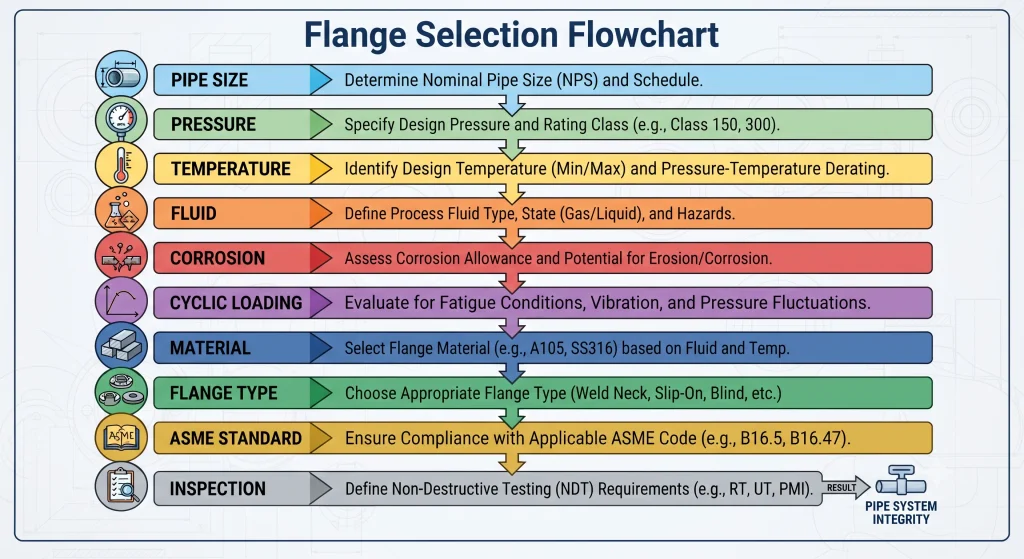
Finally, confirm the applicable standard and project specification. The flange type, material, facing, pressure class, gasket and bolting should be considered as one complete connection.
A good flange selection process therefore looks like:
Pipe → Pressure → Temperature → Fluid → Corrosion → Loads → Material → Flange Type → Standard → Inspection
This approach is far more reliable than choosing a flange based on price alone.
Frequently Asked Questions About Weld Neck and Slip-On Flanges
What is the main difference between a weld neck flange and a slip-on flange?
A weld neck flange has a tapered hub and is normally butt-welded to the pipe. A slip-on flange slides over the pipe and is typically secured with fillet welds. This difference affects fabrication, stress distribution and suitability for demanding services.
Is a weld neck flange stronger than a slip-on flange?
A weld neck design is generally preferred for demanding mechanical and cyclic conditions because its tapered hub provides a smoother transition between the flange and pipe. However, actual performance depends on the complete design, material, pressure-temperature conditions and governing code.
Are slip-on flanges cheaper than weld neck flanges?
Yes. Weld neck flanges are widely used in demanding pressure and temperature applications. The exact flange pressure class, material and suitability must be confirmed against the applicable standard and piping design.
Can slip-on flanges be used in process piping?
Yes, where the piping specification permits them and the service conditions are suitable. They are commonly used in selected utility and general-service applications.
Which flange is better for high-temperature service?
A weld neck flange is generally preferred for demanding high-temperature service because of its tapered hub and butt-welded connection. Material selection and thermal cycling also need to be evaluated.
What materials are available for weld neck flanges?
Depending on the manufacturer and specification, weld neck flanges can be available in carbon steel, stainless steel, alloy steel, duplex, super duplex, nickel alloys, Monel, Alloy 20, Inconel, Hastelloy, titanium and copper nickel, among other materials.
What standard covers weld neck and slip-on flanges?
ASME B16.5 is a major standard covering pipe flanges and flanged fittings for NPS 1/2 through NPS 24. The current ASME listing is B16.5-2025.
Should I choose a weld neck flange only because it is stronger?
Not necessarily. Over-specifying every connection can increase cost and fabrication requirements without providing a meaningful benefit. The correct flange should match the actual service conditions and project specification.
How do I choose between a weld neck and slip-on flange?
Evaluate pipe size, pressure, temperature, fluid chemistry, corrosion, vibration, thermal cycling, external loads, material, applicable piping code, inspection requirements and project specifications. The final selection should be based on the complete engineering design.
Final Thoughts
The choice between a weld neck flange and a slip-on flange is ultimately a question of matching flange design to service conditions.
A weld neck flange offers a tapered hub and butt-welded connection that make it particularly suitable for demanding pressure, temperature, cyclic and mechanically stressed applications. A slip-on flange offers simpler installation and can be an economical solution for suitable utility and general-service piping.
Neither design should be considered universally superior. The best flange is the one that satisfies the requirements of the actual piping system.
Material selection is equally important. Depending on the process environment, Jade Special Metals can address flange requirements involving stainless steel, carbon steel, alloy steel, duplex, super duplex, nickel alloys, Monel, Alloy 20, Inconel, Hastelloy, titanium and copper nickel.
Before ordering, always verify the flange type, nominal size, schedule, pressure class, facing, material grade, applicable standard, gasket, bolting and inspection requirements.
When the service is demanding, choosing the right flange is not an area where guesswork pays. Good flange selection is a small engineering decision that can have a major impact on piping reliability, maintenance and long-term plant performance